
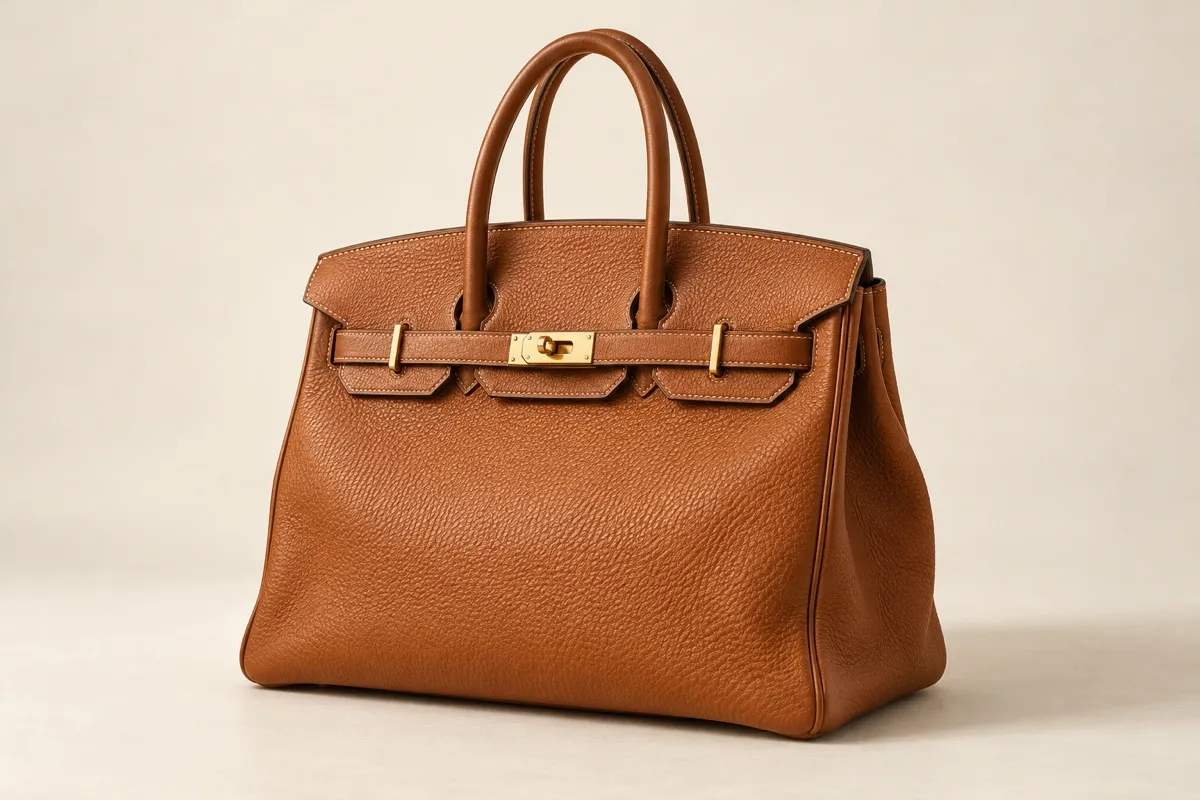
Before the Birkin became a shorthand for luxury, its origin story concerned an ordinary frustration: a bag that did not hold what its owner needed. Hermès links the design to a conversation between Jane Birkin and Jean-Louis Dumas during a Paris–London flight. The house dates that encounter and the bag’s creation to 1984.[2]
The most useful way into the story is not to imagine the precise dialogue. It is to follow the movement from a person’s needs to a design, then from that design to an actual object. Jane Birkin’s surviving original makes those stages unusually tangible.
The brief behind the bag
In Hermès’s account, Birkin wanted a bag suited to life as a young mother. Dumas responded with a roomy, supple holdall, including space for baby bottles. This is a story about capacity and use, even if the object later accumulated meanings far beyond them.[2]
That practical beginning matters because it gives the design a different emphasis from the Kelly’s public story. The Kelly was an existing bag whose association with a celebrated wearer transformed its recognition. The Birkin’s official narrative places the wearer’s requirements within the design process itself. The two bags should not be treated as interchangeable examples of the same naming anecdote.[1][3][2]
A practical brief also leaves room for choices. How a bag is carried, how deeply it opens and how its fittings occupy the surface are connected questions. A recognizable design emerges when those decisions work together, not merely when a famous name is attached at the end.
The original is dated 1985
Sotheby’s catalogued Jane Birkin’s original bag in its July 2025 sale as a 1985 object: black Box leather, brass hardware, her initials and a fixed shoulder strap. The catalogue gives dimensions of 36 centimeters wide, 21 deep and 27 high, excluding the handles.[4]
That date does not need to displace Hermès’s 1984 creation date. One describes the house’s account of the design’s beginning; the other is an auction attribution for a surviving bag. Nor does either settle every detail of the flight story. Sotheby’s accompanying retrospective article places the encounter in 1981, unlike Hermès. An exact flight date therefore deserves caution rather than confident embellishment.[2][4][6]
The original’s fixed strap is particularly instructive. It reminds us that a prototype need not match the familiar later form in every detail. A bag made for one person can embody a set of decisions that a wider design family subsequently changes.[4]
Read the fittings before the legend
Sotheby’s specialist account identifies several distinctive features of the original, including its closed metal rings, smaller feet and an Éclair inner zip. These observations make the bag more than a generic illustration of a famous model. They give it a specific construction history.[6]
Its personal details are equally revealing. The same account describes the initials J.B., a nail clipper attached to the bag and stickers supporting humanitarian organizations. Rather than treating wear as an interruption of the design, these traces invite us to consider use as part of the object’s biography. The owner did not merely supply a name; she made the bag recognizably hers.[6]
This does not mean every mark has a fully recoverable story. An object can preserve evidence of handling without preserving the circumstances of each scratch or attachment. The pleasure of looking closely is compatible with leaving those small histories open.
From private use to public interpretation
The Sotheby’s lot lists an original charity-auction certificate signed by Jane Birkin and dated 5 October 1994, together with a Poulain Le Fur auction catalogue dated 12 May 2000. These are catalogued supporting documents, distinct from the later narrative written around the bag. They provide specific points in its documented public life without reconstructing every intervening owner or event.[4]
The V&A subsequently included Jane Birkin’s first bag in Bags: Inside Out. Within a museum’s exploration of function, identity and making, the object could be considered for more than its market position. Its capacity, alterations and association with a wearer became parts of a wider history of what bags do.[5]
The original Birkin is compelling because it holds those layers together. It is a named design, a particular surviving example and a possession adapted by its owner. Keeping those layers separate does not diminish the story. It restores the person and the practical object behind a name that can otherwise become an abstraction.
Sizes, leathers and resale prices are on the Birkin profile →
Sources & further reading
- Six generations of artisans · Hermès1956Consulted 2026-10-27
- All about the Hermès Birkin bag collection · HermèsOpeningConsulted 2026-10-27
- All about the Hermès Kelly bag collection · HermèsOpeningConsulted 2026-10-27
- The Original Birkin crafted for Jane Birkin 1985 · Sotheby’sLot 8 Description · IncludesConsulted 2026-10-27
- About the Bags Inside Out exhibition · Victoria and Albert MuseumStatus and IdentityConsulted 2026-10-27
- 7 Secret Details About Jane Birkin’s Original Birkin Revealed · Sotheby’s, Morgane HalimiHistory · Details 4,5,6 · Personal-use paragraphs; Stamped J.B.; Final Fun FactConsulted 2026-10-27