
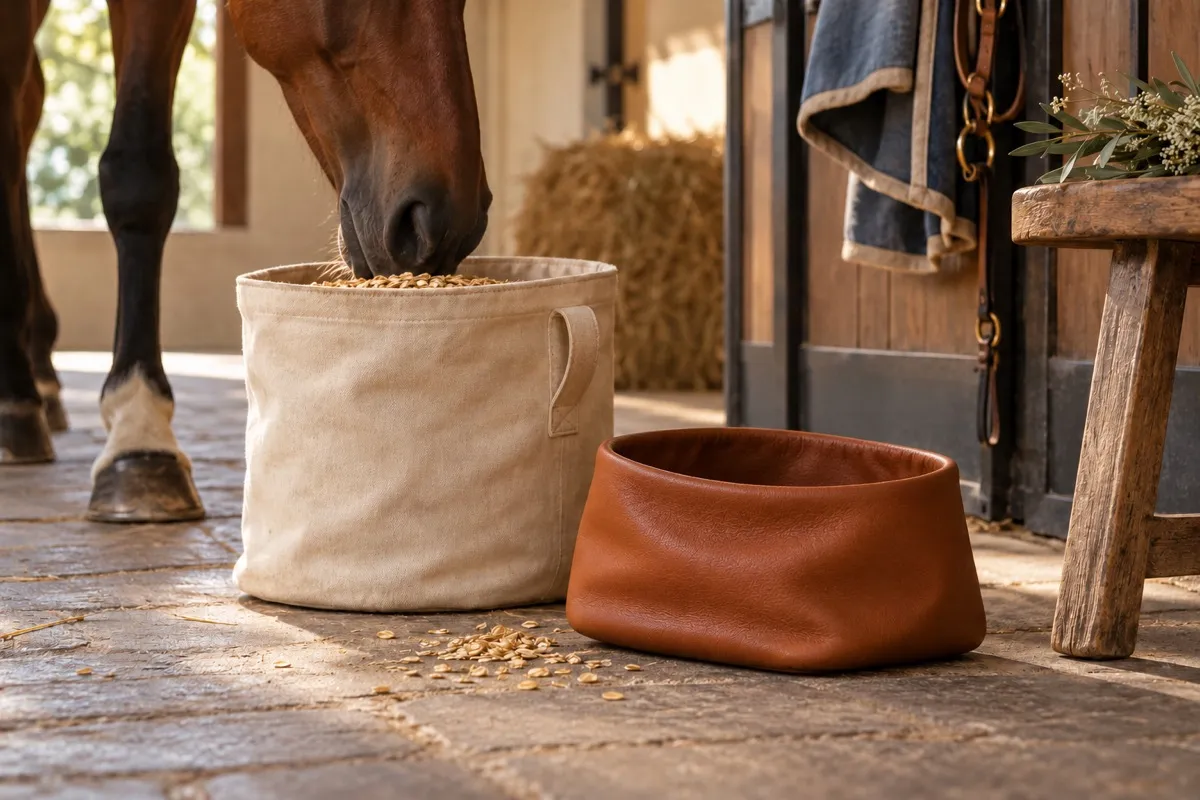
The Picotin looks back to the stable without being an old stable bag. Hermès’s published chronology places it in 2002; Christie’s likewise describes a launch that year. That distinction matters. An inherited source of inspiration and the date of a new design can be separated by a very long time.[1][3]
An everyday container, reconsidered
Hermès identifies horse feeders as the starting point and connects the name with an old French measure of oats given to a horse. The name therefore belongs to the same practical world as the shape. This is the house’s account of the naming, not a reason to invent an exact historical volume or a particular stable scene.[2]
Christie’s describes the bag’s construction as turned: stitched inside-out to produce softened edges. The effect is worth considering alongside the feed-bag reference. Rather than reading only the outer contour, look at how an edge behaves, where it rounds away and how the body of the bag gathers around its opening.[3]
The Lock is a specification, not the whole chronology
The Picotin Lock 18 reference described by Hermès has a leather cord and lock closure and is intended to be carried by hand. These are details of the listed Lock version. The 2002 entry in the house’s chronology names the Picotin, without documenting when the lock became part of the design family.[2][1]
It is more revealing to keep those statements separate than to push every familiar feature backwards to the first year. A model’s introduction, a later alteration and an individual example are different kinds of historical information. The compact word “Lock” should not disappear when describing the object in front of us.[2][1]
Let the material remain visible
Hermès’s account distinguishes unlined leather versions from canvas-and-leather versions with outside pockets. These are not interchangeable descriptions of one universal Picotin. A pocket adds a second place to put something; a change of material alters the way the surface is read. The family resemblance need not erase those differences.[2]
The unlined version offers an especially direct invitation to look at the container itself. Follow the rim towards the interior, then back to the fastening. The pleasure is in seeing how little is needed to establish a recognizable object. The Picotin’s history is not a retreat into the past, but a modern return to a useful, ordinary idea.[2][1]
Sizes, leathers and prices are on the Picotin profile →
Sources & further reading
- 2014 Annual Report · Hermès InternationalPrinted p. 19 / PDF index 20: 2002 Picotin bagConsulted 2026-10-27
- Picotin Lock 18 bag, reference H056289CK3Y · HermèsThe story behind · Product description, lines 40–53Consulted 2026-10-27
- Hermès Picotin · Christie’sOpening paragraph · Second paragraphConsulted 2026-10-27