

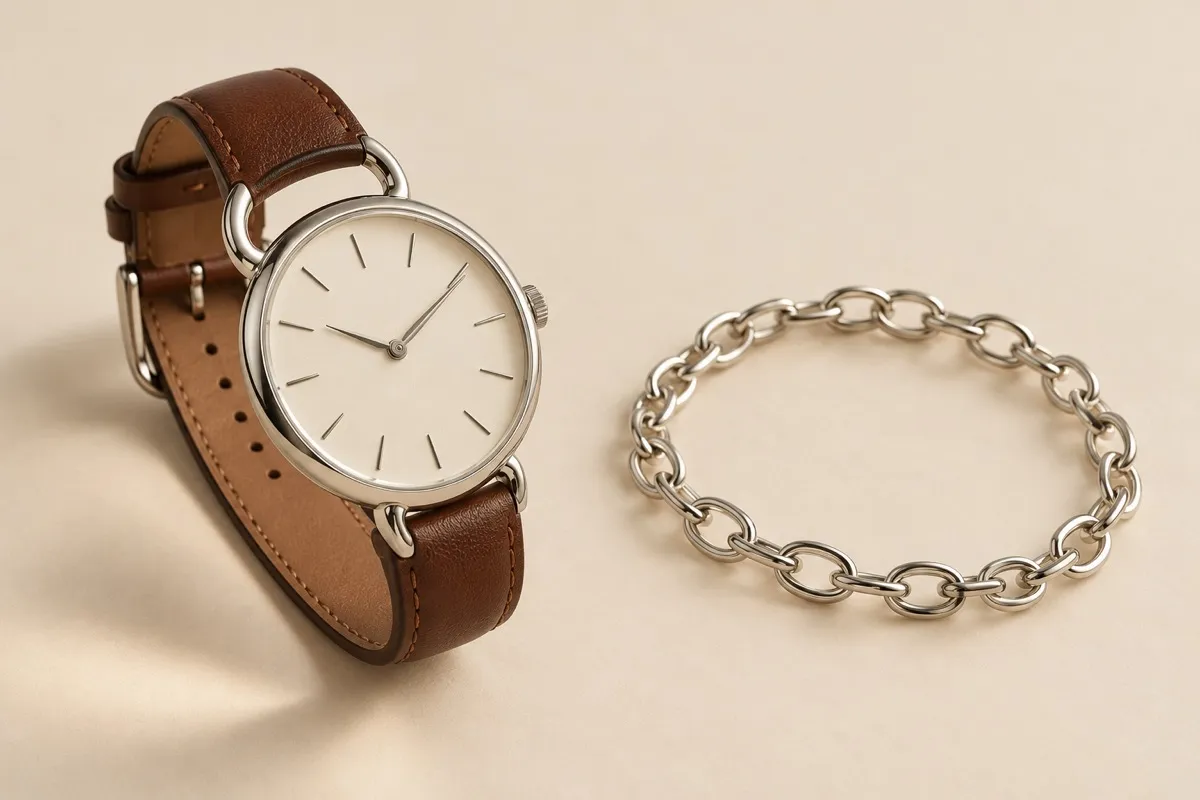
Put a watch beside a chair and the comparison initially seems absurd. One is held close to the skin; the other supports the whole body. Yet both ask a designer to negotiate structure and contact and both can make a small junction unusually expressive. Hermès objects become more interesting when they are allowed these unexpected neighbours. Watches, jewelry and furniture are not minor diversions from a story about bags. They reveal other ways that a design vocabulary can work.
A watch begins at the connection
Hermès established La Montre Hermès in Biel/Bienne, Switzerland, in 1978. The Fondation Haute Horlogerie also dates Henri d’Origny’s Arceau to that year. Its description identifies the stirrup-shaped lugs and the asymmetry between the upper and lower attachments. Look there rather than only at the dial. The connection between strap and case turns a functional requirement into the organising idea of the watch.[2]
D’Origny’s Cape Cod, launched in 1991, offers another geometric problem: a square dial within a rectangular outline. The foundation connects its lugs with the Chaîne d’ancre jewelry motif. In 1998, Martin Margiela gave the watch a double-tour strap in his Hermès runway presentation. A change around the wrist altered how an existing design was worn without requiring an entirely new watch face. It is a compact example of dialogue between disciplines, rather than a claim that one designer authored every component.[3]
Jewelry has its own scale
Pierre Hardy’s biography dates his arrival at Hermès to 1990 and his appointment to its jewelry creative direction to 2001. The first haute bijouterie collection came in 2010, according to Hermès’s own chronology. These are different milestones: taking responsibility for a field and presenting a particular new collection should not be collapsed into the same event.[4][1]
Jewelry invites us to think at a scale where an edge can become the whole subject. A curve is seen close up; a fastening may be both mechanism and ornament. An equestrian association need not mean a literal miniature of riding equipment. It can also reside in the handling of a loop, a link or a tension between rigid and flexible parts. This is a way of looking, not a claim that every resemblance establishes a documented design source.
Leather leaves the wardrobe
The relationship with Jean-Michel Frank reaches back to 1924. Hermès’s furniture history describes Frank entrusting leather covering for chairs and sofas to Jean-René Guerrand, Émile Hermès’s son-in-law. It also records work on furniture and wall coverings. Here, leather is neither luggage nor clothing. It becomes an architectural surface, giving a room the intimacy of a material normally encountered much closer to the body.[5]
That shift changes the questions a viewer can ask. How does a covering turn a corner? Where does it stop? Does the surface emphasise a volume or soften it? A room-scale object can expose the consequences of decisions that remain almost invisible on a small accessory. Looking across the two does not require treating furniture as an enlarged handbag. It means recognising that related techniques can produce objects with quite different purposes and emotional effects.
Petit h: begin with what already exists
Founded in 2010, petit h provides a different point of departure. A Hermès press release dated September 2021 describes work beginning with materials no longer needed by other métiers, including leather, crystal and porcelain. Artisans, artists and designers develop objects from that available material. In the same release, a collaboration with the Ravel pottery workshops includes an earthenware jar fitted with a leather handle from a Kelly bag.[6]
The jar is instructive because its interest does not depend on disguising where its parts came from. An element can retain a trace of an earlier use while taking on a different function. That is a specific design method, not sufficient evidence for a sweeping environmental claim about a whole company. It also offers a useful conclusion to this tour: heritage need not be confined to preserving completed models. It can reside in techniques, materials and connections that remain available for another use.
Sources & further reading
- Six generations of artisans · Hermès2005 / Pierre-Alexis Dumas, paragraph referring to 2010Consulted 2026-10-27
- Arceau · Fondation Haute HorlogerieLaunch Year; first descriptive paragraph · Second descriptive paragraphConsulted 2026-10-27
- Cape Cod · Fondation Haute HorlogerieLaunch Year; first descriptive paragraph · Second descriptive paragraph · Second and third descriptive paragraphsConsulted 2026-10-27
- The Designer · Pierre HardyBiography paragraph beginning In 1990Consulted 2026-10-27
- Meuble à secrets: Rééditions J.-M. Frank par Hermès · HermèsStory paragraphs beginning En 1924 and C’est le débutConsulted 2026-10-27
- Petit h: re-creation comes back on September 13 · Hermès InternationalPDF p.2, opening capitals · PDF p.2, first body paragraph · PDF p.2, paragraph beginning Four times a yearConsulted 2026-10-27