
The Kelly’s history begins before the name Kelly. That is the first distinction worth making about a bag so closely associated with one person. Hermès credits Robert Dumas with creating the women’s bag with straps in the 1930s. Grace Kelly’s later association gave it another identity, but the design already existed.[3]
The distinction changes how we look at it. Instead of treating the bag simply as a souvenir of celebrity, we can examine the relationship between an established shape, an individual wearer and a name that eventually became inseparable from both.
A recognizable arrangement
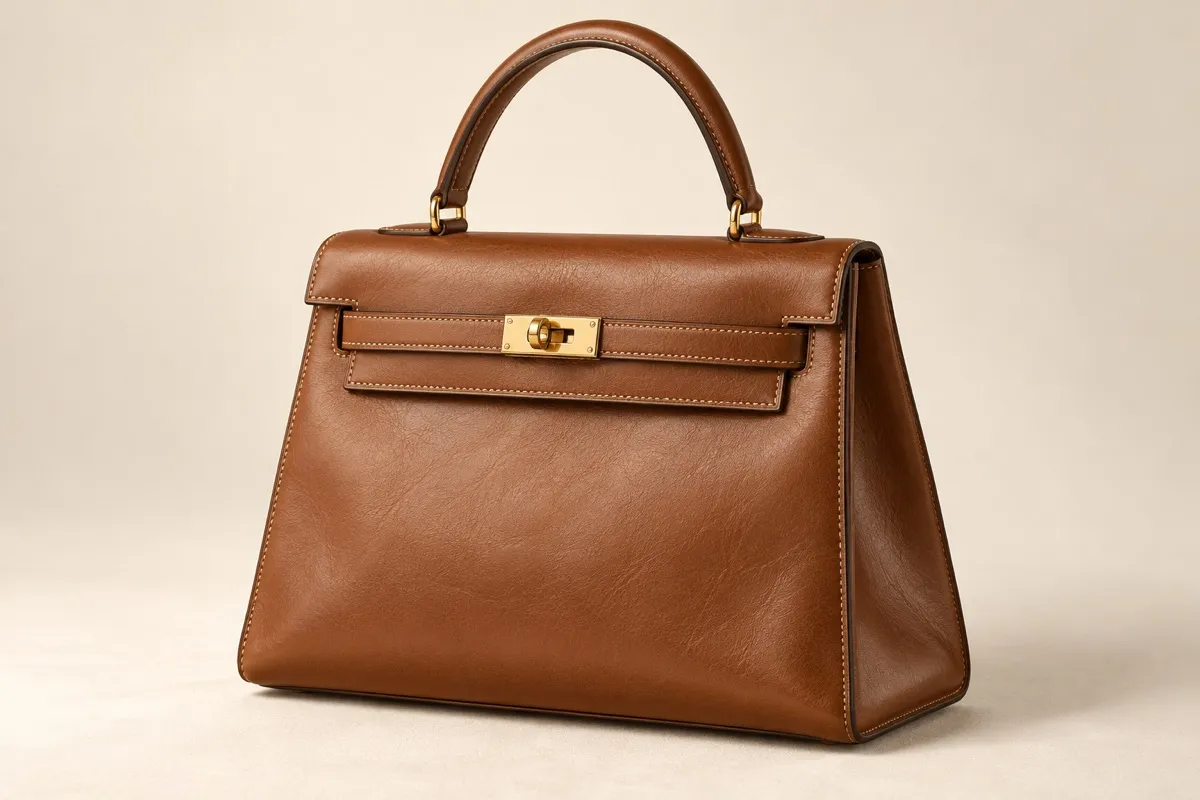
The Kelly is built around a trapezoidal outline, a top handle and a fastening across the front. Its straps and turning closure are not merely labels added to a blank surface. They organize the appearance of the bag and make the act of opening it part of its character.[4]
Seen from the front, the form directs attention towards its upper section: the handle, flap and fastening. The wider base gives that arrangement a visual foundation. This is a reading of the design rather than a claim about an undocumented intention, but it helps explain why a Kelly remains recognizable when its size or material changes.
Hermès’s own description emphasizes the continuity of the trapezoid through different formats. It also identifies the touret, or turning clasp and padlock as signature details carried into related designs. Recognition therefore depends on a group of relationships, not on one decorative device alone.[3]
What happened in 1956
Hermès’s historical account identifies 1956 as the moment when a photograph of Grace Kelly carrying the bag circulated internationally. Its dedicated Kelly page repeats the familiar story that she held it before her stomach to conceal her pregnancy. These are the house’s retrospective descriptions of the episode, rather than a newly established account of the photographer’s circumstances.[1][3]
The dating of the name is less uniform than the broad story suggests. Hermès’s 2014 annual report places the official naming in 1956; Christie’s Kelly overview gives 1977. Those statements should not be silently combined into a supposedly exact sequence. The secure central point is the association with Grace Kelly in 1956. The chronology of a formal renaming remains disputed in the published accounts consulted here.[2][4]
Similarly, Christie’s gives 1935 and the earlier name Sac à Dépêches, whereas Hermès’s own current history uses the broader 1930s. For the design’s origins, that broader date avoids turning a frequently repeated year into more precise evidence than it actually is.[3][4]
Objects make the story more particular
An auction catalogue can be most useful when it describes a specific surviving object. In the Collection of Elizabeth Taylor, Christie’s catalogued a black alligator Mini Kelly as late 1960s, measuring 20 centimeters, with gold-tone hardware. This is evidence for the object as attributed and dated by the auction house. It is not proof of the exact year in which every small Kelly format first appeared.[6]
That modest distinction opens a more interesting view of the design. Miniaturization changes the relationship between body, handle and fastening. A small bag does not need to tell precisely the same practical story as a larger one, even when its outline belongs unmistakably to the same family.
Christie’s also catalogued a sterling-silver Mini Kelly as circa 1990s, with a width of 13.5 centimeters. Here the familiar arrangement crosses into a very different material. The result can be read almost as an object portrait: the design is recognizable enough for a metal version to refer back to a leather bag without reproducing its usual feel or behaviour.[7]
A name is not the whole object
The Victoria and Albert Museum included the Kelly in the celebrity and identity section of Bags: Inside Out. That context is illuminating. A bag can carry possessions and also carry associations, projecting a public image while enclosing a private interior.[5]
The Kelly’s appeal to historical inquiry lies in the meeting of those two roles. Grace Kelly explains an important part of its cultural recognition. The earlier design, the fastening and the later experiments in scale and material explain why the story does not end with a photograph. Looking closely means allowing the object to remain more than its famous name.[1]
Sizes, leathers and resale prices are on the Kelly profile →
Sources & further reading
- Six generations of artisans · Hermès1956Consulted 2026-10-27
- 2014 Annual Report · Hermès InternationalPrinted p.17:1956Consulted 2026-10-27
- All about the Hermès Kelly bag collection · HermèsOpening · Masculine Harmony; Once a KellyConsulted 2026-10-27
- Hermès Kelly bags · Christie’sOpening · Opening two paragraphsConsulted 2026-10-27
- About the Bags Inside Out exhibition · Victoria and Albert MuseumStatus and IdentityConsulted 2026-10-27
- A black alligator Mini Kelly bag · Christie’sDetailsConsulted 2026-10-27
- A rare sterling silver Mini Kelly · Christie’sTitle and DetailsConsulted 2026-10-27