
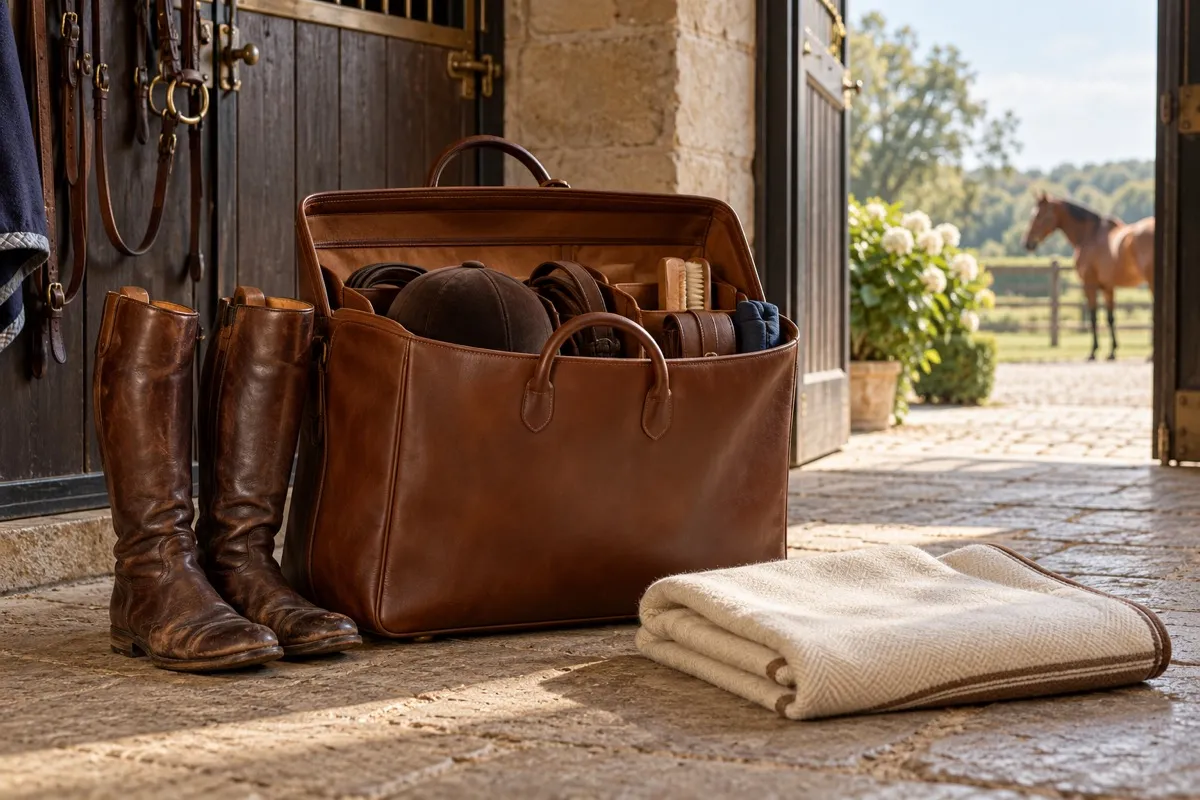
Before asking what a Haut à courroies resembles, ask what it had to contain. Hermès describes its first bag as a carrier for riders’ boots and saddles. That original purpose gives the design a physical scale of thought: it begins with equipment, not with a list of small personal essentials.[2]
Around 1900, not an invented birthday
The house’s 2014 chronology dates the bag to circa 1900. Its 2022 chronology uses 1900 without the qualification. “Around 1900” preserves the more cautious wording; neither entry supplies a precise first sale or a day on which the design was completed.[1][4]
Authorship also deserves care. The 2014 Hermès report names Émile Hermès, while the French intellectual-property institute INPI credits Charles-Émile in its historical overview. The disagreement should remain visible rather than being resolved by choosing the more familiar family name. A secure date range and purpose are more useful than false biographical certainty.[1][3]
Volume before resemblance
Hermès describes tall, trapezoidal lines and a flap that can tuck inside to make a broad opening. Look at the opening as well as the closed silhouette. The difference between containing something and reaching it is one of the most practical questions a bag can answer.[2]
The fastening supplies another point of attention: two straps pass through guides and meet at a turning clasp, called a Touret. Rather than treating the fittings as ornament scattered across the surface, follow their route. The horizontal fastening gathers the upper part of the bag while the body retains its sense of height.[2]
The house links the shift towards travel luggage with the arrival of the automobile. It does not give an exact year for that change of use. The interesting continuity is the capacity to carry a substantial load: a form developed around equestrian equipment could be understood again in another setting.[2]
A family does not have only one way to travel
The contemporary HAC à dos shows a further adaptation. Hermès describes it as carrying the signature details into a design with an adjustable strap, worn on the back or at the side. This is a related format, not evidence that the early Haut à courroies was itself a backpack.[2]
The older bag deserves attention on its own terms. Its history need not be reduced to the objects that followed it. Watch how height, opening and straps cooperate, then how another carrying system changes that balance. The Haut à courroies makes continuity tangible without requiring every generation to make the same journey.[2]
Sources & further reading
- 2014 Annual Report · Hermès InternationalPrinted p. 17 / PDF index 18: circa 1900Consulted 2026-10-27
- Sac Haut à courroies · HermèsOpening paragraph · Trapèze Toujours; Volume de Caractère · Détails Élémentaires · Citadin dans l’ÂmeConsulted 2026-10-27
- Hermès : de la selle au carré (1837) · Institut national de la propriété industrielle (INPI)First historical paragraph, line 23Consulted 2026-10-27
- 2022 Universal Registration Document · Hermès InternationalPrinted p. 11 / PDF index 12: Hermès in key dates,1900Consulted 2026-10-27