
What could a saddle and a guitar have to do with one another? The connection is more interesting if we resist answering with a vague idea of craftsmanship. Petit h begins with something concrete: an existing part that might do a different job. The guitar offers a way to examine that proposition without turning a surprising object into a slogan about reinvention.
The part before the finished object
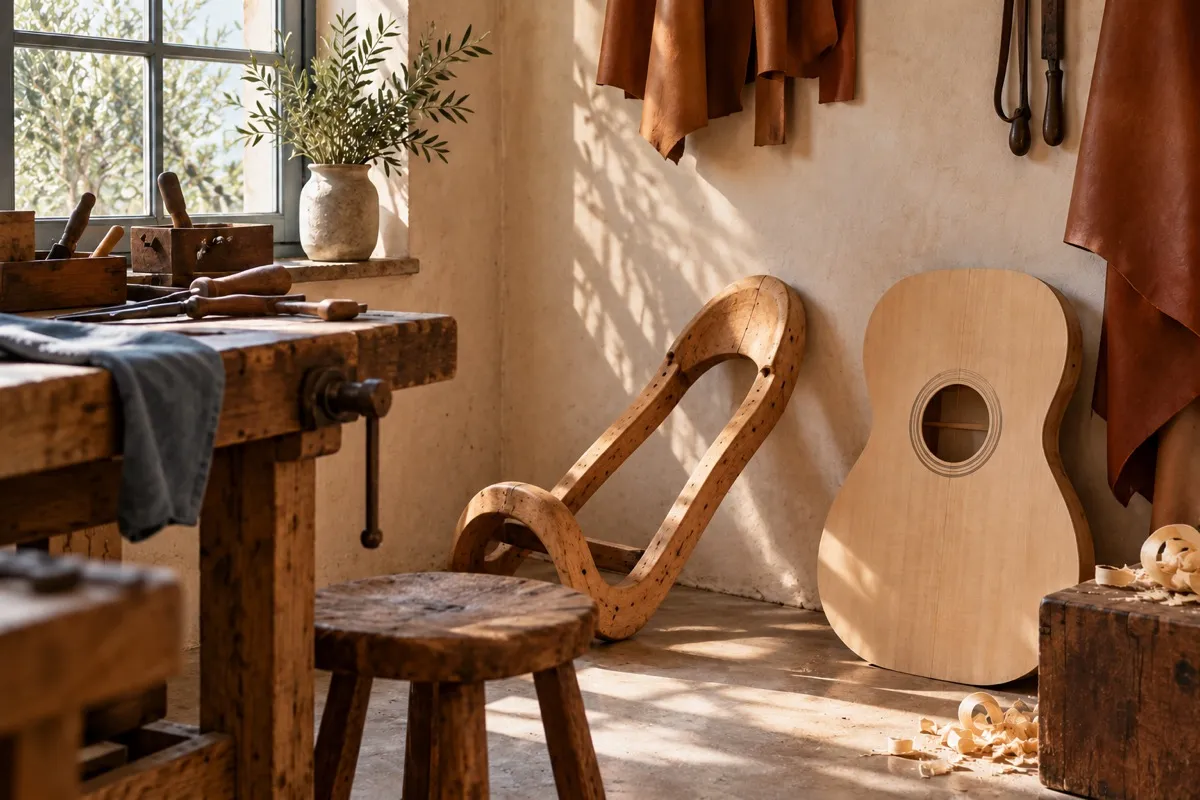
Hermès describes saddle trees from the 1960s entering the petit h workshop from the Conservatoire des Créations Hermès. In the house’s account, this structural heart of the saddle becomes a starting point for several objects, including a guitar. The decade belongs to the source material. It does not date the guitar and the story is not that a finished musical instrument had somehow been waiting in the archive all along.[1][+][+]
A more specific documentary marker appears in the 2020 Activity Report, which names an electric guitar and an Arçon chair among petit h’s creations. That establishes their place in the reported work of the period, rather than a precise first-making date. Set beside the saddle-tree account, it gives the guitar a context while leaving its full construction history open. There is no need to invent one to appreciate the proposal.[2]
A brief written by the material
Petit h itself was founded in 2010. A September 2021 Hermès release describes a process that begins with materials other métiers no longer need, rather than with a predetermined design. Makers combine and adjust what is available. Here, the existing part is not simply a cheaper substitute for something already specified. It participates in setting the brief: what could this shape, surface or connection become?[3][+]
The guitar makes the change of purpose particularly vivid. It asks us to imagine a structure in a different relationship with the body: no longer as part of riding equipment, but as part of an object associated with playing. That comparison is enough. Without a technical account or a listening test, there is no basis here for describing the instrument’s tone, balance or performance.
A different kind of authorship
The workshop’s authorship is also collective. The 2021 release names Godefroy de Virieu as artistic director and describes the participation of artisans, artists and designers. That does not establish him as the guitar’s sole designer. The distinction matters because an object assembled across skills can be diminished by giving all its decisions to one person. Direction and individual making are related roles, not interchangeable credits.[3]
Hermès’s saddle-tree account also includes a sledge, a bench, a basket and a vase. The variety suggests why it is useful to look at the starting structure before the final category. A curve need not have only one destination. In this reading, the archive supplies possibilities rather than instructions; the maker’s task is to discover which new relationship makes the retained part worth noticing.[1]
As a design story, the guitar belongs beside the other unexpected objects of the house. It shows a method, not a quantified environmental result: the sources do not establish the project’s material savings or wider impact. Its immediate fascination is more particular. A part associated with one activity is allowed to enter another, carrying enough of its earlier identity to make the encounter surprising.
Sources & further reading
- Petit h: the hundred and one lives of the saddle tree · HermèsThe hundred and one lives of the saddle tree, lines 15–16, first sentence · The hundred and one lives of the saddle tree, line 16, second sentence · The hundred and one lives of the saddle tree, line 16Consulted 2026-10-27
- Activity report 2020 · Hermès InternationalPhysical PDF p.39, petit h column, lines 2124–2135Consulted 2026-10-27
- Petit h: re-creation comes back on September 13 · Hermès InternationalPhysical PDF p.2, opening capitals, lines 10–14 · Physical PDF p.2, first prose paragraph, lines 15–19Consulted 2026-10-27