

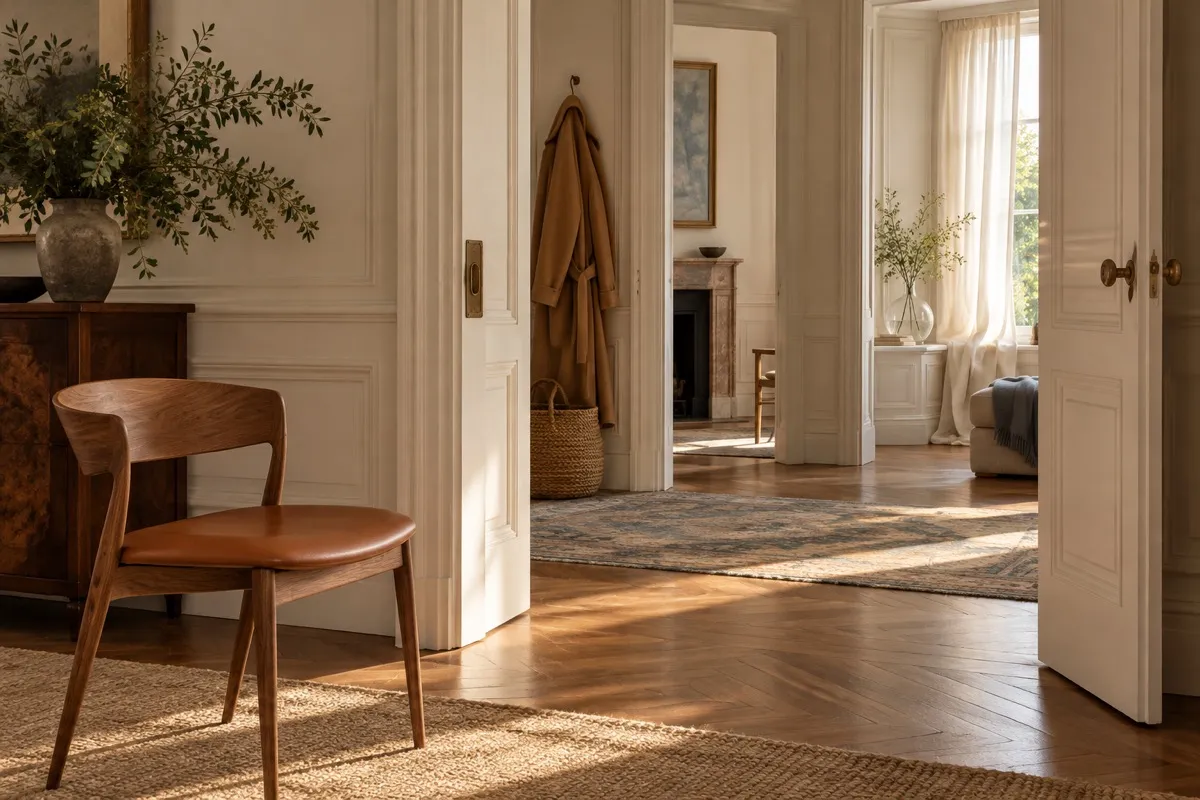
A handbag is an understandable place to begin with Hermès. It is a less useful place to stop. Set it beside a coat, a perfume bottle, a watch and a chair and the familiar name starts to describe something more interesting than a single category of desirable possessions. Each object asks different things of its maker. Each meets the body differently. Together, they offer a way into a history that is as much about changing uses as enduring appearances.
Begin with a problem, not an emblem
The business began as Thierry Hermès’s Paris harness workshop in 1837. Its later expansion did not simply replace the horse with the handbag. The company’s own chronology records a golf jacket in 1925, jewelry in 1927 and watches and sandals in 1928. That sequence matters: clothing and small objects were already part of the story well before many of its most familiar modern associations took shape.[1][+]
One way to read this history is to look for the practical question inside an object. What must bend? What must support weight? Where should a fastening fall? How does a surface feel after prolonged contact? These are useful questions whether the subject is a riding accessory or a garment. They do not prove that every later design descended directly from a saddle. They give us a more attentive way of looking than identifying a logo and moving on.
Different métiers, different kinds of attention
The French word métier can mean a trade or craft. Here it is a reminder that several bodies of knowledge coexist under one name. In 1967, Catherine Karolyi was entrusted with the women’s wardrobe; in 1978, La Montre Hermès established a dedicated watchmaking operation. Neither clothing nor watches should be treated as a decorative footnote to leather goods. Their histories involve their own makers, design decisions and measures of success.[1][+]
A garment is experienced in motion. A watch must be read as well as worn. A necklace sits between an image and a small piece of engineering. A chair changes the relation between a body and a room. These differences are worth keeping visible. If everything becomes an illustration of one supposedly timeless style, the distinctiveness of the individual objects disappears. A more revealing question is how the same visual idea behaves when it moves between materials and scales.
A history that cannot all be photographed
Perfume makes that question especially vivid. Eau d’Hermès, composed by Edmond Roudnitska in 1951, established an important point in the house’s fragrance history. A photograph can preserve the bottle but not the experience of its contents. Scent therefore asks a heritage project to work differently: to distinguish a launch date, a creator’s intention and a person’s response, rather than pretending these are the same kind of evidence.[2]
Objects for the home open another door. Hermès traces its collaboration with Jean-Michel Frank to 1924, when the designer entrusted leather covering for furniture to Jean-René Guerrand. The interest lies less in turning a room into a branded ensemble than in seeing a technique travel. The edge, the join and the meeting of soft and rigid materials become part of the furniture’s character. This is a relationship between design and making, not just between a label and a new market.[3]
Look for the individual hands
There is no need to reduce this many-sided history to a procession of solitary geniuses. Nor should the individual designers disappear into an anonymous corporate voice. The most rewarding approach holds both perspectives together: the named author and the workshop; the new proposal and the existing vocabulary; the object as conceived and the object as used. A creator can sharpen our understanding of a house without being responsible for everything it produces.
This independent guide follows those connections rather than ranking objects by prestige. It moves between established designs and less familiar corners, asking what changed, who contributed and what the surviving evidence can actually tell us. Bags remain part of that picture. So do scent, clothing, domestic objects and the small choices that make a thing recognisable. The point is not to find a single key to Hermès, but to notice how many doors its history contains.
Sources & further reading
- Six generations of artisans · Hermès1837 / Thierry Hermès, first paragraph · 1925 / Creation of new métiers · 1967 / First women’s ready-to-wear collection · 1978 / Jean-Louis DumasConsulted 2026-10-27
- Terre d’Hermès Pure Perfume press dossier · Hermès ParfumsPDF p.10, Hermès Perfumer, openingConsulted 2026-10-27
- Meuble à secrets: Rééditions J.-M. Frank par Hermès · HermèsStory, paragraph beginning En 1924Consulted 2026-10-27