
Hermès Crocodile Niloticus leather
Nile crocodile, matte or shiny: the skin of the Himalaya.
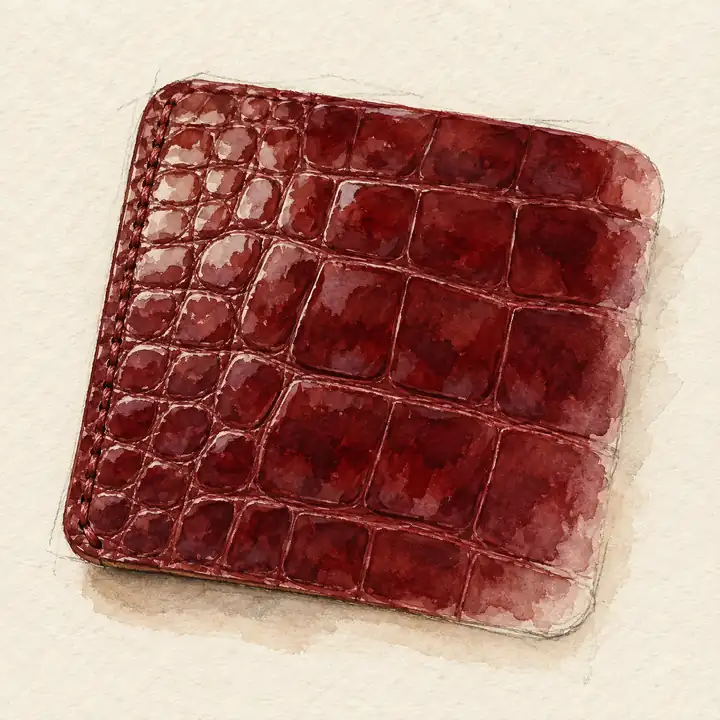
Crocodile Niloticus is the Nile crocodile, Crocodylus niloticus. Its scales are slightly larger and less symmetrical than those of Porosus and are often described as a little softer. Hermès offers it matte or shiny. It is the skin of the famous Himalaya, a matte Niloticus hand-dyed from smoky gray to white, which the house said made a strong comeback in 2019.
A few things worth knowing
- Nile crocodile populations are on CITES Appendix II in thirteen countries and Appendix I everywhere else.
- Collectors identify Hermès Niloticus by two dots beside the Hermès stamp.
- On the resale market, shiny Niloticus was asked at about 2 times Togo for the same bag in our October 2026 snapshot.
Crocodile Niloticus at a glance
- Family
- Exotic skins
- Since
- Not published
- Grain
- Larger scales, matte or shiny
- Boutique price versus Togo
- Not published
- Resale versus Togo
- 2.04 times Togo
- Share of listings
- under 1%
Our ratings
- Scratch resistance
- 6/10
- Holds its shape
- 8/10
- Lightness
- 6/10
- Rain and water
- 3/10
- Easy care
- 4/10
- Color depth
- 7/10
- Patina
- 6/10
- Visible natural grain: no
- Embossed grain: no
- Structured look: yes
- Made for daily use: no
- CITES paperwork to travel: yes
Our take. These ratings are MyQuotaBag's editorial view, built from the sources listed below and from collectors' experience. They are not measurements. Resale versus Togo and share of listings are measured from public listings.
On this page
Origin and history
Hermès does not say where its Niloticus comes from. Collectors' guides speak of the Nile region or Zimbabwe. The house states that all its crocodilian tanneries belong to the international crocodilian farmers' association and that, in 2025, all raw crocodilian skins came from farms audited by a third party.
Look and feel
Larger scales than Porosus, with pores often barely visible. Matte is soft and satiny, a finish Hermès obtains with wool felt; shiny is polished with an agate stone to a glassy finish.
How it wears
Water. The enemy: a water spot can be permanent and the skin can swell where it gets wet.
Scratches. Many owners say crocodile rarely scratches or stains; water is the real problem.
Aging. It develops a patina; after a year or two of use, a bag looks lived in.
Care
Like alligator: keep it from rain, creams, sun and heat. Resellers suggest a spa visit every two years.
Who it suits
Matte for careful daily use, shiny for occasions and collections.
Travel and resale rules
- Travel. Up to four crocodilian items for personal use usually travel without a CITES document in the United States, the EU and the UK, never for an Appendix I population. Keep the document proving your bag's origin.
- California. A 2023 final judgment blocked the state's ban for Nile crocodile from populations covered by the US special rule. Bags from other populations may still be affected. We found no appeal as of October 2026.
- New York. Selling any crocodilian requires a state permit.
This is not legal advice.
Where the sources disagree
- Durability. Some resellers call Niloticus more durable than Porosus; one of them admits the ranking is mostly marketing. No measurement exists.
Crocodile Niloticus resale prices
Median asking prices, October 19, 2026. US dollars, from public resale listings, not confirmed sale prices.
On the resale market, a Crocodile Niloticus bag is listed at about 2.04 times the price of the same bag in Togo, same model, size and condition. This is the median over 4 comparable groups.
| Bag | Condition | Median asking | Same bag in Togo | Listings |
|---|---|---|---|---|
| Birkin 25 (shiny) | Pre-owned | US$51,600 | US$28,600 | fewer than 20 |
| Birkin 30 (shiny) | Pre-owned | US$47,900 | US$23,000 | about 20 |
| Birkin 30 (matte) | Pre-owned | US$45,000 | US$23,000 | fewer than 20 |
| Birkin 30 | Pre-owned | US$46,500 | US$23,000 | fewer than 20 |
| Kelly 28 (shiny) | Pre-owned | US$39,800 | US$20,000 | fewer than 20 |
| Kelly 32 (shiny) | Pre-owned | US$39,000 | US$15,600 | fewer than 20 |
Think of these figures as a snapshot of the market rather than a valuation of any particular bag. Explore resale prices by bag, size and year.
Frequently asked questions
What is the difference between Niloticus and Porosus?
Niloticus has slightly larger, less symmetrical scales; Porosus has small, square scales, each with a visible pore; it costs more at the boutique.
What is a Himalaya bag?
A matte Niloticus crocodile bag hand-dyed in a gradient from smoky gray to white.
References
- Hermès International, Universal Registration Documents 2019 and 2025.
- CITES Appendices and the IUCN Crocodile Specialist Group.
- US Code of Federal Regulations, 50 CFR 17.42 and 23.15.
- California Penal Code section 653o and the 2023 final judgment on crocodilian products.
- Resellers' guides to Hermès exotic skins.
- Hermès, care instructions for precious leathers.
About this guide
MyQuotaBag brings together what is known about each Hermès leather, from brand material, tanneries, regulators, the press and collectors. It also says where the sources disagree. Ratings are our own view. Resale figures are public asking prices, not confirmed sales or valuations.
MyQuotaBag is independent and is not affiliated with or endorsed by Hermès.
How to cite: MyQuotaBag, « Hermès Crocodile Niloticus leather », Hermès Leathers, resale snapshot of 2026-10-19. https://myquotabag.com/leathers/crocodile-niloticus/