

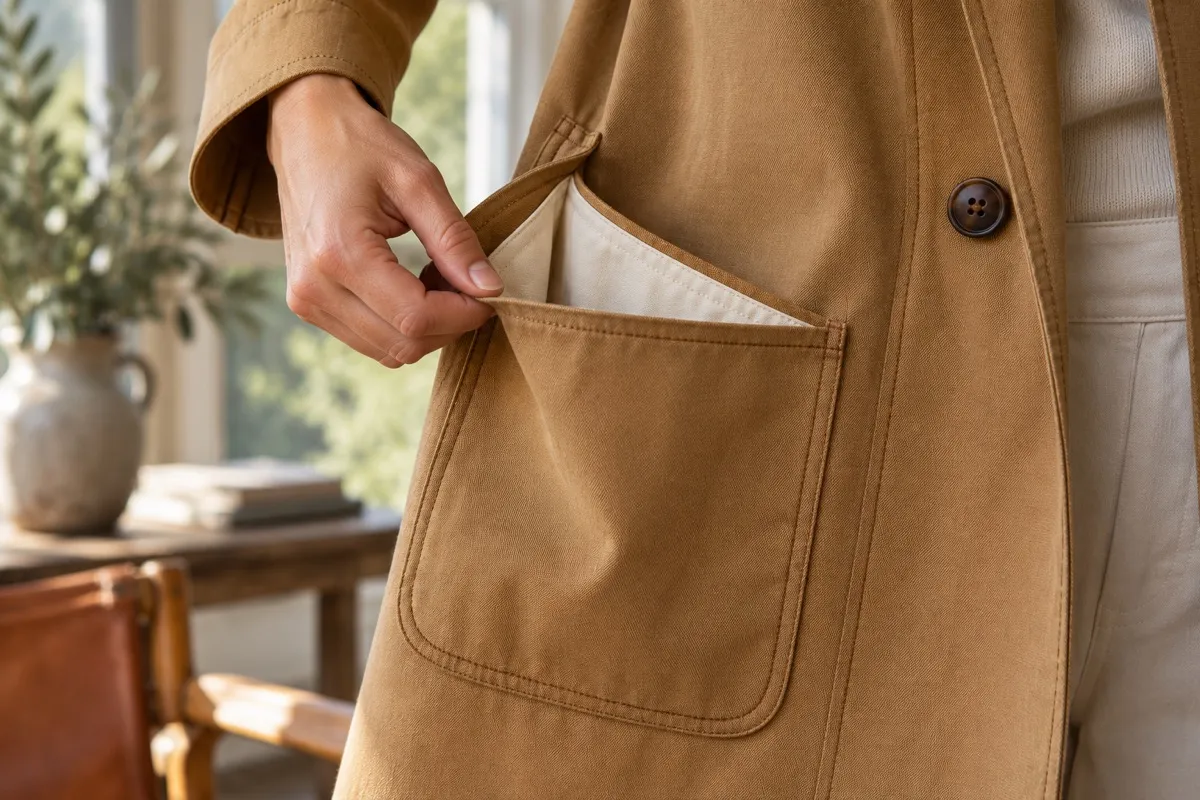
An oversized pocket or a carefully placed fastening can tell us a great deal about a designer’s priorities in a particular collection. In Hermès’s account of Nadège Vanhée-Cybulski’s summer 2020 wardrobe, pockets expand and equestrian harnesses become a starting point for coat and skirt fasteners. Heritage enters at the point where a person uses the garment. It is a useful place to begin looking at her work.[4]
Arriving with experience
Hermès appointed Vanhée-Cybulski to women’s ready-to-wear in July 2014; she presented her first collection in March 2015. The International Woolmark Prize’s biography identifies it as autumn–winter 2015 and records earlier roles at Maison Martin Margiela from 2005 to 2008 and Céline from 2008 to 2011. Those are professional coordinates, rather than a formula from which every later design can be predicted.[1][2]
Her remit was the women’s wardrobe. The creators chapter sets that role beside the designers who preceded her, while the wider house includes many other creative responsibilities. Looking closely at womenswear avoids making one person stand in for every Hermès object. It also gives small decisions in a coat or dress the attention they deserve.[1]
The material changes the idea
The 2017 activity report provides another close view. It describes cotton drill with contrasting topstitching and lightweight leather pieces in fine lambskin or calfskin, with perforations creating effects of light and shade. These details make material an active part of design. The reader can follow the difference between a line drawn on paper and a surface whose weight, finish and openings change how that line is experienced.[3]
The same report attributes to Vanhée-Cybulski the principle that an Hermès object should be as beautiful inside as outside. Paraphrased without turning it into a promise about every garment, this is a helpful invitation to look beyond the front view. Construction and finish belong to the object’s experience even when they are not what a passing spectator sees first.[3]
Adaptation over time
In 2020, the house described an autumn–winter collection organised around suits, outdoor clothing and kilts, with outerwear in materials including double-face cashmere and quilted calfskin. Its 2025 report, naming her Nadège Vanhée, records reversible coats and adaptable zip arrangements. Read together, these examples offer a thread through different seasons: clothing as something the wearer can use and adjust, with history feeding practical choices rather than remaining a distant reference.[4][5]
This portrait follows those documented collections through 2025. Its invitation is simple: start with one useful detail, then look at what the designer has made it do. A fastening can connect a contemporary wardrobe to the house’s equestrian past without asking its wearer to dress as a historical figure. The detail carries the story into everyday movement.
Sources & further reading
- 2014 Annual Report · Hermès InternationalPDF p.38, Women’s Ready-to-Wear, final paragraph; reused C-C017 · PDF p.38, Women’s Ready-to-Wear, final paragraphConsulted 2026-10-27
- Nadège Vanhée-Cybulski judge profile · International Woolmark PrizeBiography, web line 17Consulted 2026-10-27
- Rapport d’activité 2017 · Hermès InternationalPrinted p.45 / PDF p.46, Le prêt-à-porter femme, lines 2731–2745 · Printed p.45 / PDF p.46, opening attributed statement, lines 2723–2726Consulted 2026-10-27
- Activity report 2020 · Hermès InternationalPDF p.34, Women’s Ready-to-Wear, summer paragraph; lines 1766–1776 · PDF p.34, Women’s Ready-to-Wear, autumn-winter paragraph, lines 1777–1794Consulted 2026-10-27
- 2025 Universal Registration Document · Hermès InternationalPrinted p.29 / PDF p.31, §1.6.2.1; reused C-C018 and C-C020Consulted 2026-10-27