
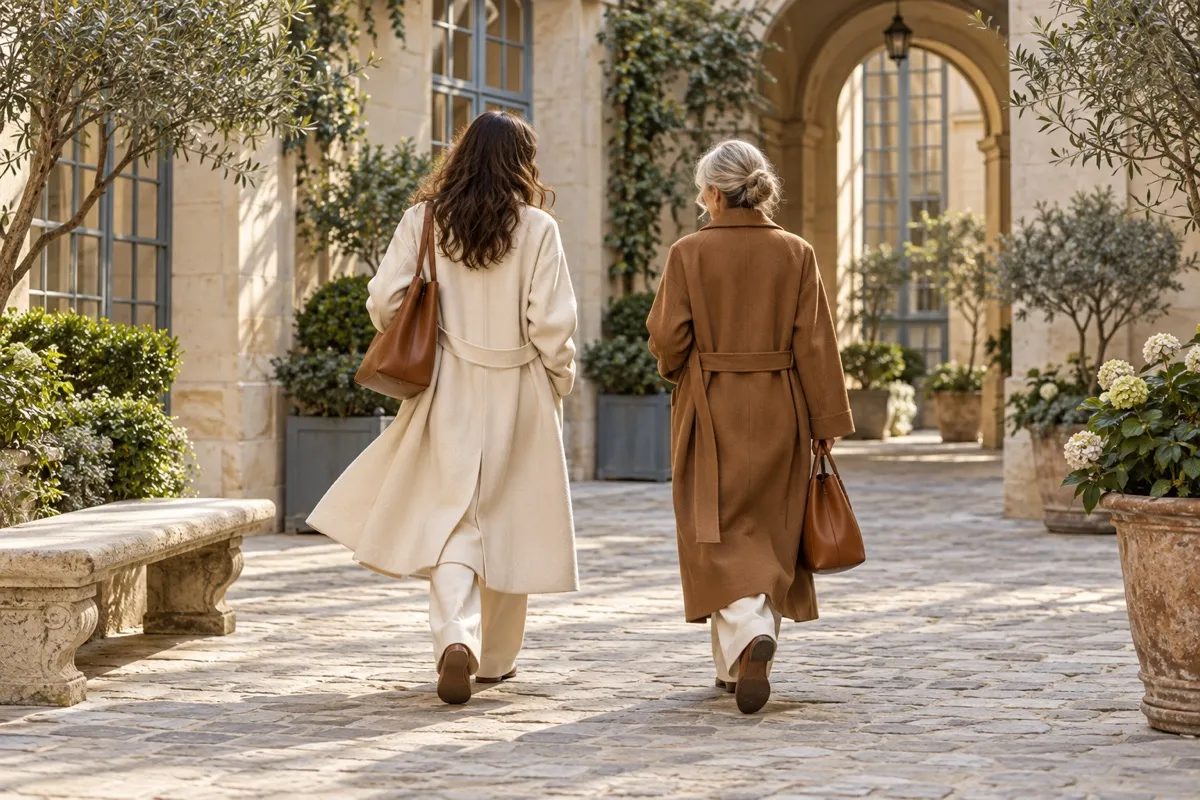
A trench coat that can be worn in different ways is a particularly good introduction to Martin Margiela at Hermès. MoMu includes one in its account of his work with the house, alongside a film demonstrating the garment in use. The interesting question is what happens after a design leaves its hanger. How much freedom does it give the person putting it on?[3]
The designer before Hermès
Margiela graduated from Antwerp’s Academy of Fine Arts in 1980, worked as Jean Paul Gaultier’s assistant from 1984 to 1987 and founded Maison Martin Margiela with Jenny Meirens in 1988. His Hermès women’s collections followed between 1997 and 2003. The sequence places him inside a working history of fashion: training, collaboration and an independent practice before taking responsibility for another house’s wardrobe.[1]
A wardrobe needs a wearer
MoMu’s account gives unusual importance to the women presenting those Hermès clothes. It describes casting across ages from 25 to 65, with an emphasis on mature assurance and natural movement. This shifts the reader’s attention from an isolated silhouette to a relationship. The model’s presence helps communicate what the garment is like to inhabit, rather than supplying a neutral support for a shape.[2]
For its exhibition, the museum invited three former Hermès models to appear in specially commissioned films called Les Gestuelles. There is something illuminating about returning clothes to people who can show their behaviour. A photograph holds a single arrangement still. A moving image can ask us to notice a change of position, the way fabric follows the body or the transition between one way of wearing and another.[2]
A familiar idea in another setting
The museum’s Paris exhibition page pairs two deep V-neck silhouettes: one from Margiela’s own autumn–winter 1996–1997 collection and another for Hermès in autumn–winter 1998–1999. Its caption identifies the neckline as a vareuse, derived from sailors’ clothing. Placed together, the examples suggest a designer revisiting a useful idea across different settings. Continuity becomes visible in a specific cut, rather than remaining an abstract claim about his style.[4]
Another perspective survives in a fax interview published by Vogue in July 1998 and republished in 2020. Margiela described the relationship through a shared outlook and respectful work between the two teams. His own account adds a voice to the museum’s later reading, without turning the collaboration into a story of solitary authorship.[+]
MoMu characterises the Hermès work through comfort, tactile qualities and restrained color. Those terms become more useful beside the casting, neckline and adaptable coat. They encourage close looking at what a garment permits, rather than a search for a loud signature. The creators chapter places this period in the longer succession of Hermès womenswear designers; here, the wearer remains at the centre of the picture.[5]
Sources & further reading
- Martin Margiela · MoMu Fashion Museum AntwerpOpening biography, lines 51–52Consulted 2026-10-27
- International Women’s Day: Martin Margiela and his women-centred design philosophy · MoMu Fashion Museum AntwerpCasting paragraph, lines 22–23 · Les Gestuelles paragraph, line 27Consulted 2026-10-27
- The Story Behind the Trench Coat: Deconstruction of an Archetypal Garment · MoMu Fashion Museum AntwerpCollection account, lines 31–32Consulted 2026-10-27
- MoMu travels to Paris · MoMu Fashion Museum AntwerpPaired silhouette caption, lines 40–42Consulted 2026-10-27
- Margiela the Hermès years · MoMu Fashion Museum AntwerpDescription of the exhibition, paragraph 3Consulted 2026-10-27