
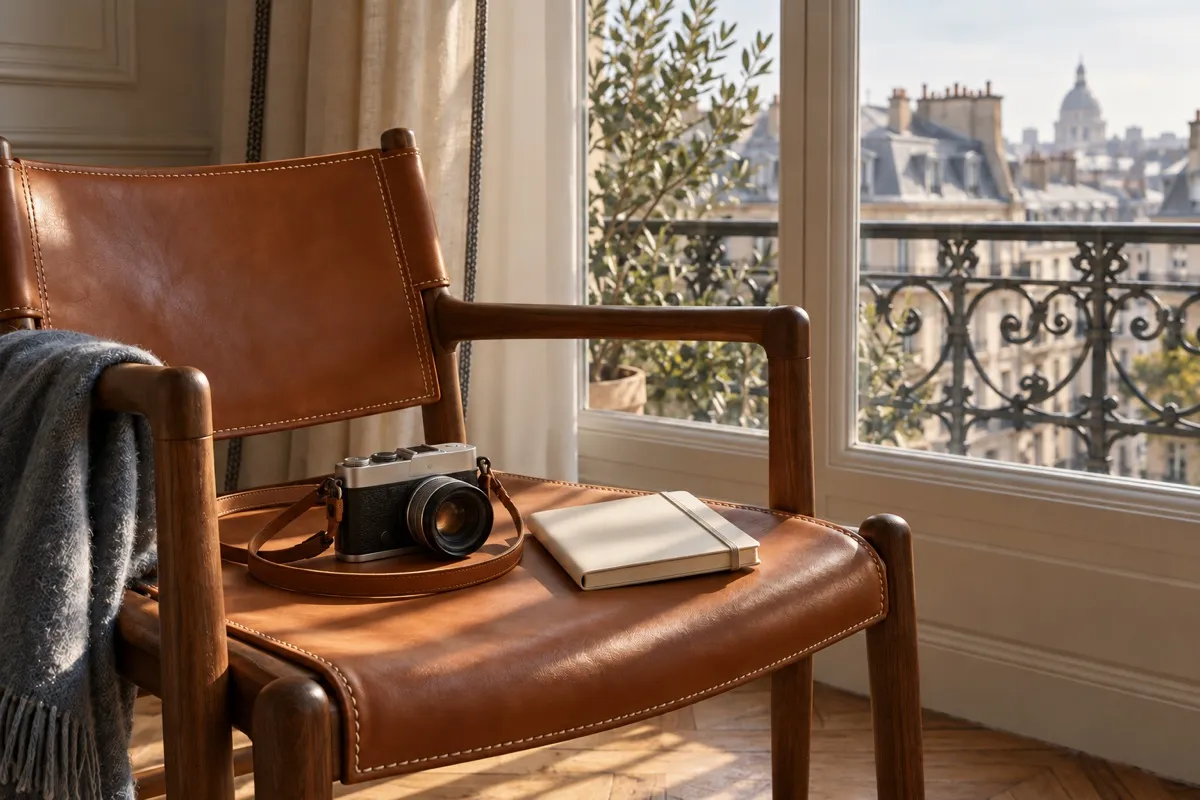
A small red notebook and an old Leica make a useful starting point for Jean-Louis Dumas. They are the two objects his publisher, Steidl, places at the beginning of its description of Photographer, his 2008 book. Alongside the business leader stands someone who kept recording the world around him. That second occupation gives this portrait its focus: the practice of paying attention.[2]
A wider field of view
Dumas took the helm of Hermès in 1978, following his father Robert. The house’s chronology associates his leadership with international expansion and new specialist activities, including La Montre Hermès that same year. Those are substantial changes of scale. A photographic notebook offers a different measure of a career, bringing it back to individual sights, encounters and moments rather than a succession of corporate milestones.[1]
Steidl describes photographs made largely in black and white during journeys with work, family and friends. The range matters. A photograph does not have to record a major occasion to deserve keeping; an apparently minor incident may become the image that stays with us. In this setting, the notebook and camera suggest a portable archive, one that can grow while its owner is occupied with something else.[2]
Pictures that travelled between people
His daughter Sandrine Dumas-Brekke adds a more intimate account in a 2012 interview with Leica. She remembers a small darkroom in the cellar of the family’s apartment building, where he developed prints. She also recalls the small photographs he gave away, annotated with messages. In her telling, the picture could function as a greeting. The act of looking continued in the act of sharing.[3]
Her recollections describe a particular relationship with photographs; they cannot explain every decision he made at Hermès. Still, they offer a welcome companion to the familiar executive portrait. They let us consider attention as something practised through repeated, modest actions: making an image, selecting it, adding a few words and passing it to another person.
Giving another designer room
MoMu’s account of Martin Margiela’s Hermès years identifies Dumas as the executive who approached him for women’s ready-to-wear. This is another useful way to see leadership: through the people invited to contribute. The subsequent clothes belong to Margiela’s work with the house, not to a fictional story in which one chairman personally authors everything. The creators chapter follows that collaboration in context.[4]
The Birkin story, which Hermès connects to Dumas’s encounter with Jane Birkin, belongs alongside this portrait rather than replacing it. So does the family history. The notebook, the camera and the published photographs leave us with something more personal: a body of images to explore, beyond the objects for which his name is most often remembered.[1]
Sources & further reading
- Six generations of artisans · Hermès1978 / Jean-Louis Dumas, line 104 · 1984 / Creation of the Birkin bag, line 111Consulted 2026-10-27
- Photographer by Jean-Louis Dumas · SteidlBook description lines 30–31; edition metadata line 42 · Book description, line 30Consulted 2026-10-27
- Jean-Louis Dumas’ Photographic Gaze, by his daughter, Sandrine Dumas-Brekke · Leica Camera BlogInterview answers, lines 25 and 32Consulted 2026-10-27
- Margiela the Hermès years · MoMu Fashion Museum AntwerpDescription of the exhibition, paragraph 2Consulted 2026-10-27