
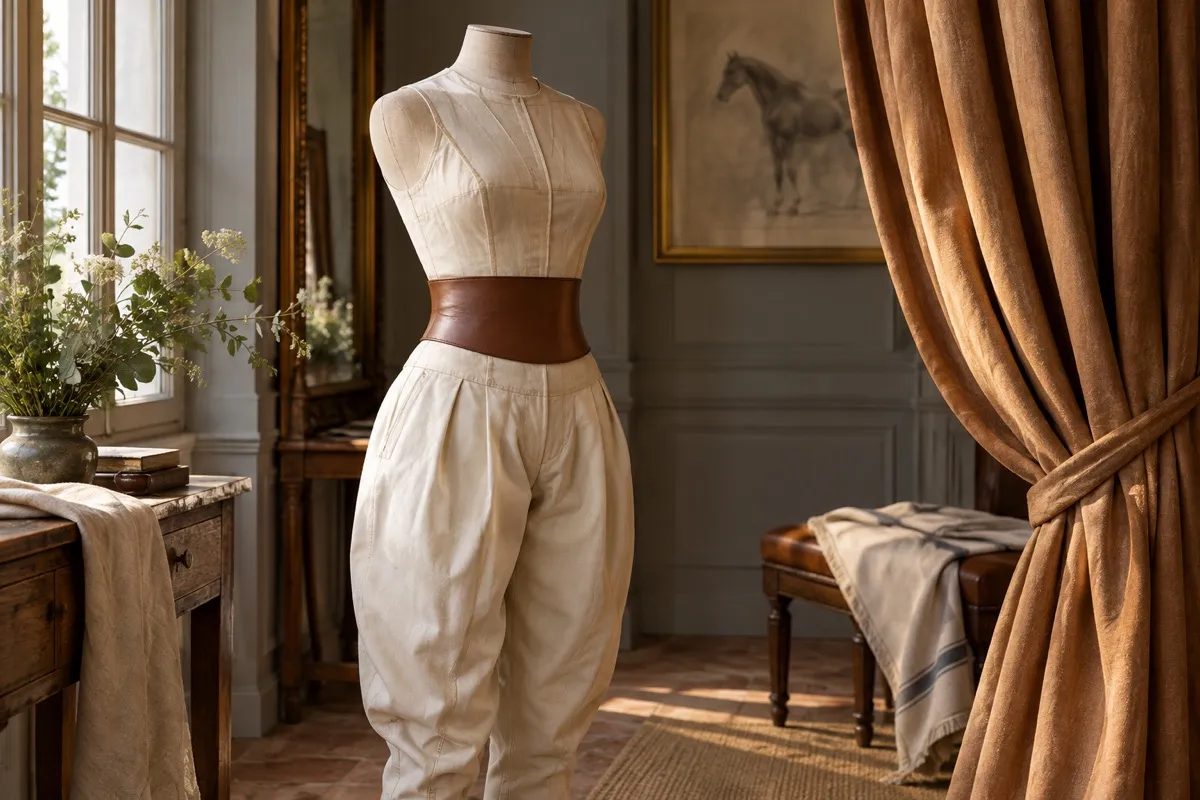
A leather corset worn over jodhpurs brings two recognisable worlds into the same silhouette. The Grand Palais’s Gaultier dossier describes this look, modelled by Nadja Auermann, at the beginning of his Hermès collaboration. The corset emphasises the outline of the torso; the riding trousers bring an equestrian reference. Their encounter is a compact introduction to Jean Paul Gaultier’s way of making familiar clothes speak differently.[1]
A vocabulary formed through making
Gaultier joined Pierre Cardin’s team in 1970, aged eighteen, according to the museum’s biography. His own house’s account opens its story in 1976 and describes a career developed without fashion school. These beginnings complicate the convenient image of an instinctive provocateur. They also place practical experience inside established fashion houses before the public identity associated with his own name.[1][2]
His official biography celebrates mixing clothes, social worlds and genres. Read as the house’s statement of his approach, that helps explain why a recognisable garment need not remain in its usual category. A corset can become an outer layer; a riding reference can enter a fashion silhouette. The pleasure for the viewer lies partly in recognition, then in seeing the familiar element placed somewhere unexpected.[2]
Working within the Hermès wardrobe
The Grand Palais dossier gives the Hermès collaboration as 2003–2010. His remit here was women’s ready-to-wear, not artistic control over every Hermès métier. Keeping that boundary clear makes the clothes easier to read on their own terms. They form one designer’s sustained contribution to a larger house, alongside creative work taking place in other departments.[1][3]
The 2010 annual report offers two revealing reference points. For spring–summer, it identifies tennis and seaside clothing of the 1930s; for autumn–winter, London in the 1960s. These are invitations to look at how an atmosphere becomes a wardrobe. A sporting reference and an urban one suggest different attitudes, yet each gives the designer a world of dress to reconsider. The collection is where those references must become actual clothes.[3]
An ending with two dates
His final collection for Hermès was spring–summer 2011, presented in October 2010. The season on the clothes and the date of the show therefore belong together; neither needs to erase the other. The creators chapter follows the handover to Christophe Lemaire. For Gaultier’s portrait, the lasting interest is in that expressive range: a wardrobe can carry character through the way a familiar form is cut, combined and presented.[3]
Sources & further reading
- Jean Paul Gaultier dossier pédagogique · Réunion des musées nationaux – Grand PalaisPrinted p.16 / PDF p.16, Le Corset, paragraph on Hermès · Printed p.8 / PDF p.8, biography, paragraph beginning Cette interrogation · Printed p.5 / PDF p.5, Le BoudoirConsulted 2026-10-27
- The designer · Jean Paul GaultierThe Designer, web line 112 · Different is Beautiful, web line 116Consulted 2026-10-27
- 2010 Annual Report French · Hermès InternationalPrinted p.35 / PDF p.37, Prêt-à-porter femme · Printed p.35 / PDF p.37, Prêt-à-porter femme; reused C-C012 · Printed p.35 / PDF p.37, Prêt-à-porter femme, final paragraph; reused C-C011Consulted 2026-10-27