
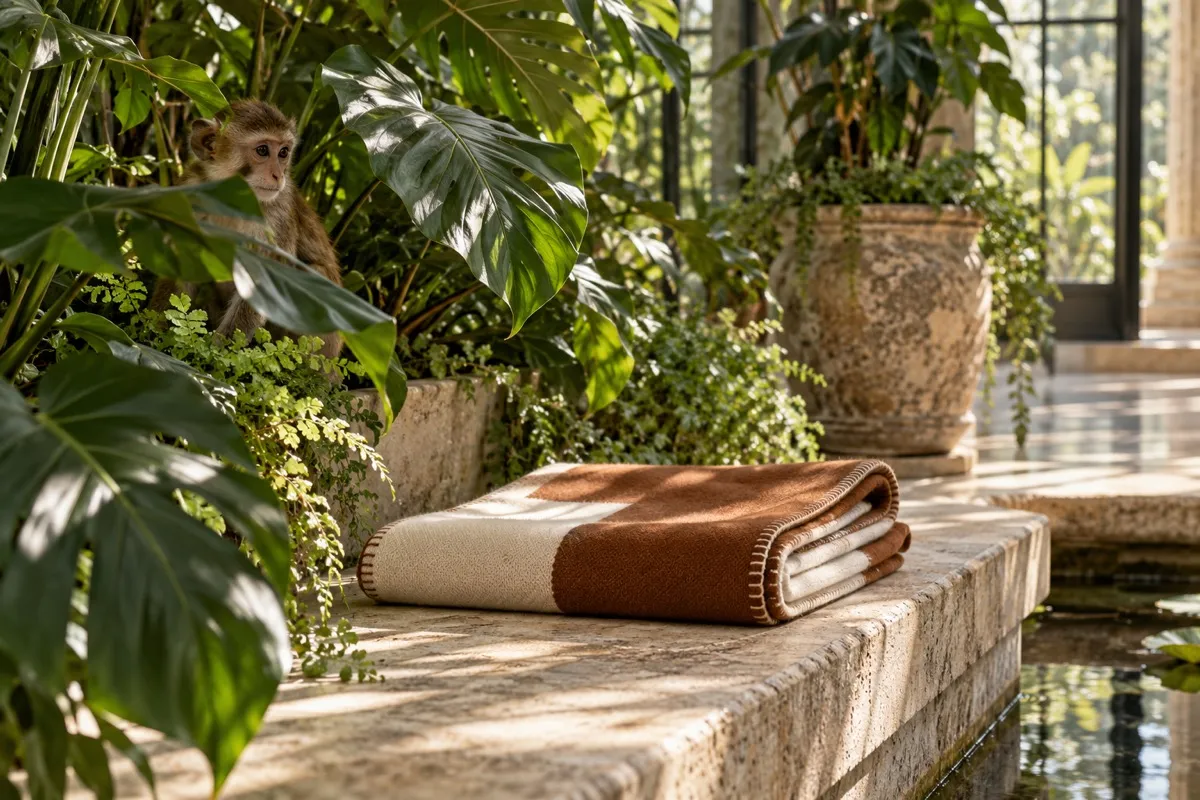
With Annie Faivre, a small detail can become a way into the whole design. Hermès itself invites viewers to look for a little monkey hidden in her work. The invitation turns looking into an activity: follow a branch, pause at a crowded corner, return to an area that first seemed merely decorative. Finding the creature is enjoyable, but the search also gives the rest of the composition time to reveal itself.[1]
Tapis de Selle offers a well-documented example of her sources. Hermès credits the design to Faivre and describes its starting point as a visit to the Émile Hermès collection. The subject is ceremonial saddle pads. These are textiles made for another body and another kind of display, translated into the space of a scarf.[1]
Flowers, palmettes and branches become part of that translation. At the corners, Hermès identifies the rounded croupelin, a saddlecloth placed over the horse’s lower back for special occasions. The detail rewards curiosity: a shape that might initially be read as ornament also has a practical name and history. Faivre’s design allows the two readings to coexist.[1]
Au Fil du Carré suggests a different sort of journey, through earlier designs. A description attributed to the Hermès autumn–winter 2011–12 booklet, reproduced by specialist dealer Abigail Goodman, says that Faivre brought together elements from eighteen of her previous scarves. Read in that light, the composition becomes a gathering of familiar places rather than simply another destination. The earlier designs remain available to be recognized within a new whole.[2]
These works offer a simple way to enjoy Faivre: look closely before trying to explain everything. Notice what repeats, what changes scale and what nearly escapes attention. The smallest discovery may be the one that sends you back to the beginning.
Sources & further reading
- Tapis de Selle scarf 90 · HermèsProduct description, line 33 · Designed by line 38 · The story behind, first sentence · The story behind, second and third sentencesConsulted 2026-10-27
- Hermès Au Fil du Carré Cashmere Silk 140 · Abigail Goodman Scarf BoutiqueAttributed booklet text, lines 133–134Consulted 2026-10-27