
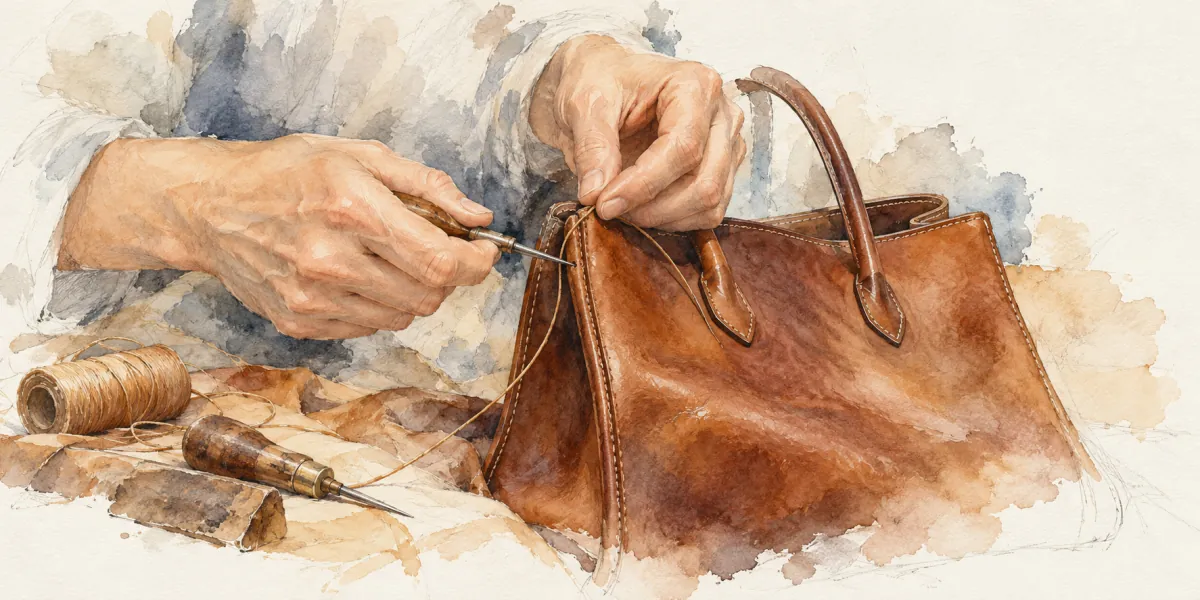
Before Béatrice Amblard made her first bag at Hermès, there was practice. In a 2019 interview, she recalls repeating stitching and edge finishing until the movements became more familiar. The bag she remembers receiving to construct was a Kelly. It is a useful place to begin her account: with the work required before a recognizable object could take shape.[3]
The distinction matters to anyone looking at a finished piece. A seam offers little record of the attempts that preceded it. We can admire the result while knowing almost nothing about how the maker learned to achieve it. Amblard’s recollection directs attention back to that less visible part of craftsmanship, without asking us to imagine a particular day at her bench.
By the time of her 2013 Feather Factor interview, Amblard described two parts of her working life in San Francisco: custom leather accessories under April in Paris and an atelier school intended to keep traditional methods in use. These were her independent activities. Her earlier experience at Hermès is part of the account, but it does not make the school an Hermès institution.[2]
Teaching adds another kind of attention. Asked about her routine in the later interview, she described checking where each student had reached, preparing the next steps and returning to assess progress. She also observed that students could develop unevenly, showing confidence in one task while struggling with another. This is her description of teaching, not an assessment of individual students made by MyQuotaBag.[3]
The school’s current professional biography presents Amélie Amblard, Béatrice’s daughter, as a teacher who completed its programme in 2015. That is a documented professional connection. It does not tell us what their private relationship is like, or make skill an inheritance that passes automatically from parent to child. The account gives us training and teaching to consider, rather than a family legend.[1]
In our reading, the most compelling continuity lies in making a difficult action understandable to another person. The teacher has to notice the point at which an explanation stops helping and a demonstration, another attempt or more time is needed. Keeping a technique alive leaves room for the learner’s pace as well as the maker’s standards.
Amblard’s school and bespoke practice are commercial enterprises; this account recommends neither a course nor a product. It follows a narrower thread through her published testimony: knowledge acquired in making can become knowledge offered through teaching. The next piece of work then belongs to someone else, even when a familiar method helped it begin.[1][2]
Sources and limits
- About Beatrice Amblard, Hermes-Trained Master Leather Artisan · Heirloom LeathercraftConsulted 2026-10-27 · opened relevant original textBéatrice lines 9–14; Amélie lines 22–25 · Self-description; historical superlatives, totals and unique-status claims excluded.
- Interview with Béatrice Amblard · Feather FactorConsulted 2026-10-27 · opened relevant original textExtracted lines 21–24 and 36–46 · Personal account; chronology not independently audited. Health and family anecdotes not retained.
- From Hermès Paris, to April In Paris. An interview with Béatrice Amblard. · Leathercraft Masterclass / PhilipConsulted 2026-10-27 · opened relevant original textParagraphs on training and routine, extracted lines 67–80 and 156–188 · Commercial craft-training publisher; personal testimony. Medical information and unsafe tool-use anecdotes excluded.
The supplied independent review reopened six core sources across these three stories. Other references retain their author's access record; no claim of exhaustive independent rechecking is made.