

Start with something small: the place where a handle joins a bag, the edge of a plate, the space between two fingers of a glove. Famous names can make an object seem familiar before we have really looked at it. Details bring us back to the useful questions. How was this made? What does this part have to do? What would happen if its shape were a little different?
Hermès describes its creative world through sixteen métiers, encompassing leather goods and equestrian objects, silk, clothing, jewelry, watchmaking, homeware and other fields. These are not sixteen interchangeable versions of one craft. A scarf and a watch ask for different kinds of knowledge. Looking across them makes the house more interesting than a story told through bags alone.[1]
Making room for the hand
In its account of saddle-making, Hermès describes leather components built around a wooden saddle tree. Structure comes before the finished silhouette. A saddle has to answer to bodies and movement, so its construction gives us a useful way into the wider subject: craft begins with a problem that an object must solve.[2]
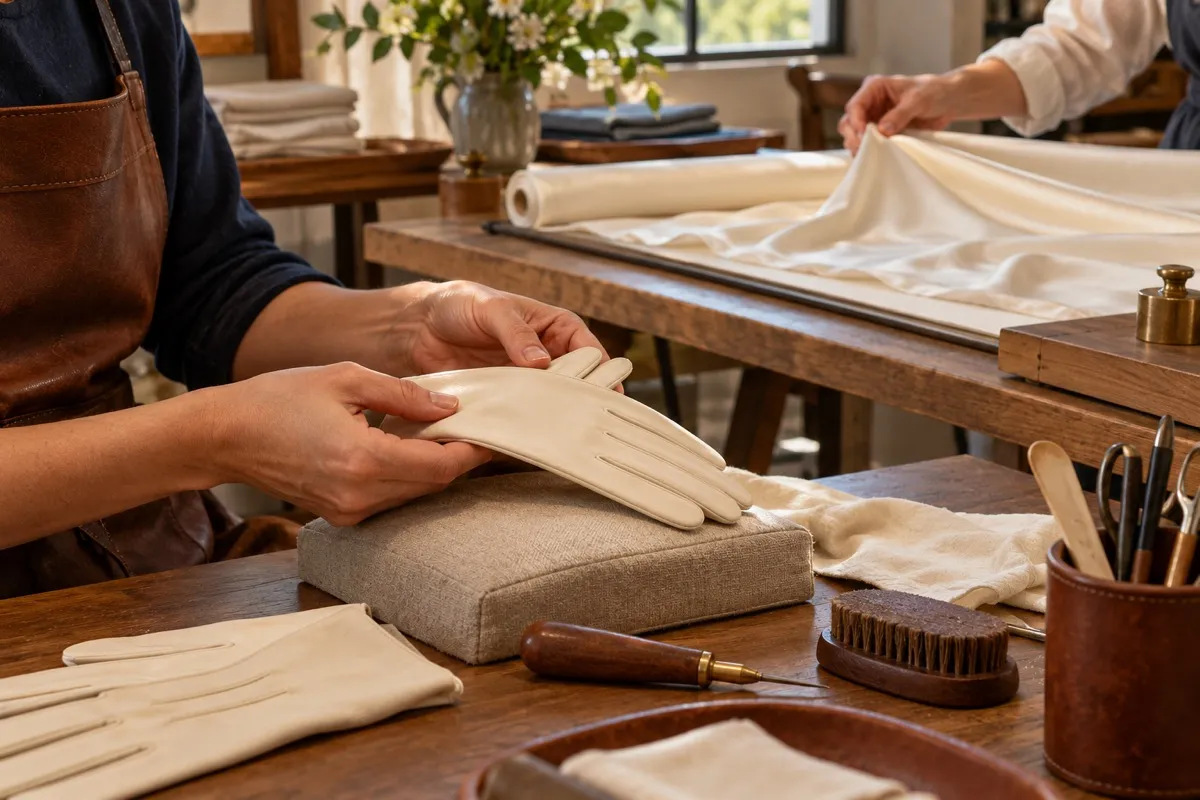
A glove brings that problem unusually close to us. Hermès describes selecting and stretching the leather before cutting its separate components and sewing them together. Look at your own hand as it opens and closes. The comfortable fit we want from a glove is already an ambitious piece of design; it has to accommodate that movement without constantly announcing its efforts.[2]
There is pleasure in noticing such decisions, even without being able to name every tool. Try following an edge with your eyes. Look at how one surface becomes another, or how a piece opens and closes. These are invitations to look more carefully, not tests that establish authenticity. A pleasing detail on its own cannot tell the whole history of an object.
Color is also a craft
For silk, the house describes a process in which a drawing is separated by color, with digital files informing the printing screens. Printed fabric is then steamed, washed and finished; the scarf edges are hand-rolled. There is room here for both skilled hands and technical systems. The presence of a screen or a digital file does not make the decisions disappear.[2][+]
Try looking at a scarf first as an image and then as something that folds. A line that looks important when the square is flat may vanish into a knot. A modest patch of color can suddenly become the whole point. This is one of the delights of a wearable picture: the person wearing it joins in, without having to preserve the designer’s full composition every time.
Porcelain asks for another translation. In the hand-painted work Hermès presents, outlines and color are applied before successive firings reveal the finished colors. Gem-setting works at a different scale again, securing stones in metal under magnification. These examples make it easier to see why the word “craftsmanship” needs specifics. A brush, a setting tool and a printing screen are doing very different jobs.[2]
Knowledge has to move
An object can be placed in an archive. A practical skill needs someone who can still perform it, explain it and help another person learn. Hermès says it develops in-house schools for leather, textiles and tanning. Its École Hermès des Savoir-Faire opened in 2021 and offers vocational qualifications in leatherwork. Training belongs inside the craft story, rather than in a footnote after the finished object.[4][3]
This also gives heritage a less static meaning. Passing on a technique asks more than preserving a tool in a cabinet. It means making the work understandable to someone who was not there before. We can admire a familiar shape while remaining curious about the people learning to make it now and about the choices they will face that earlier generations did not.
Looking beyond the signature
For a collector, a useful next step is to choose an unfamiliar kind of object. If you usually look at bags, spend time with a glove or a plate. If scarves are your starting point, look at the way a clasp moves. The exercise is not to rank the crafts. It is to discover which details attract you when a famous model name is no longer doing all the work.
There is no need to turn every encounter into a lesson. Sometimes a color is simply cheering, or a small practical detail makes you smile. Knowledge can deepen that response without replacing it. The most rewarding craft story leaves room for both: the work required to make an object and the quite personal pleasure of living with it.
Sources & further reading
- Creativity, innovation and uniqueness at the heart of strategy · HermèsThe Hermès Métiers, lines 11–43Consulted 2026-10-27
- Hermès in the Making in Istanbul · HermèsCrafting a saddle, line 28 · Making gloves, lines 54–55 · Separating the color and Printing the silk, lines 32–37 · Painting on porcelain; Setting gemstones, lines 43–48Consulted 2026-10-27
- Strategy · Hermès FinanceAn integrated craftsmanship model, line 31Consulted 2026-10-27
- Transmission of know-how · Hermès FinancePreserving historical know-how, lines 80–82Consulted 2026-10-27