
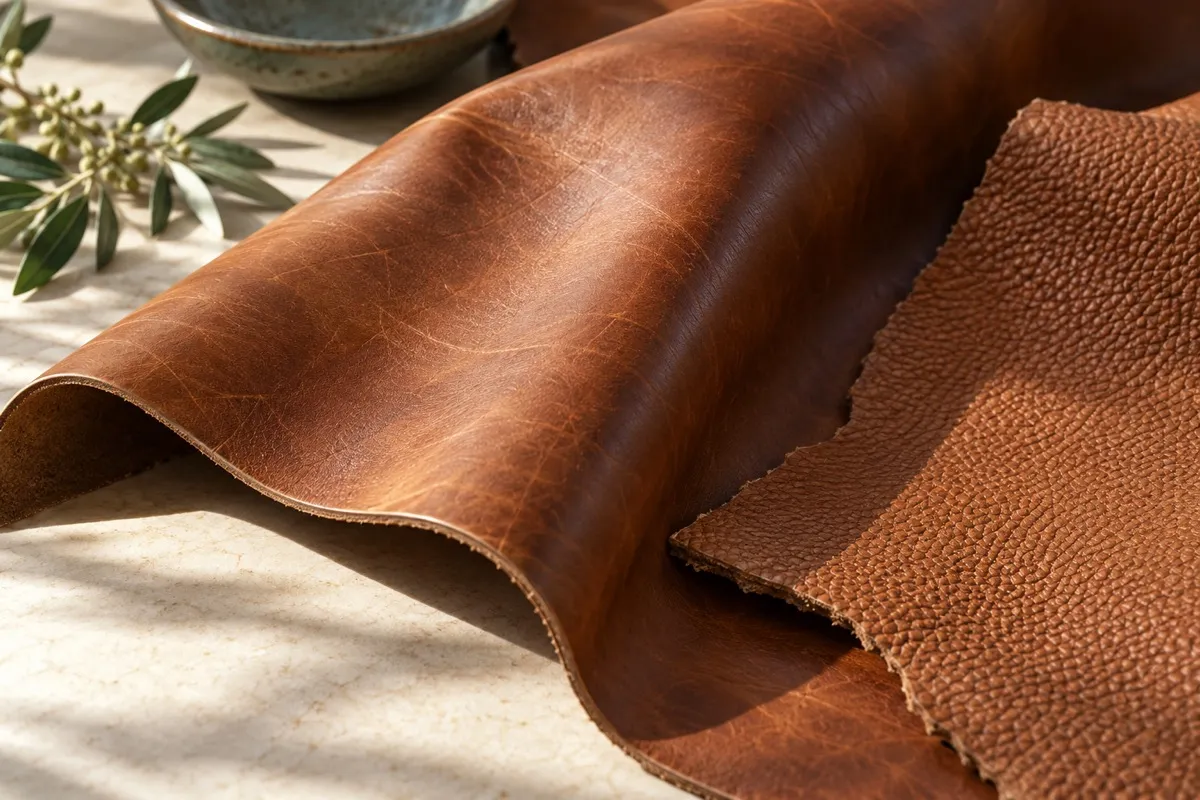
Before we learn a leather’s name, we often respond to its feel. A firm surface seems composed; a softer one invites movement. Color can look restrained in one light and unexpectedly lively in another. That first response matters. A material is part of the everyday pleasure of an object, not merely a line to memorise in a catalogue.
Understanding it begins with a little precision. The Canadian Conservation Institute explains that leather’s characteristics depend on both the animal skin and the way it is processed and finished. Tanning changes the skin chemically to improve its stability and durability. A surface may also be modified during processing. “Leather” therefore names a family of materials rather than a single, predictable experience.[2]
Look at behaviour, not only the name
A useful way to look is to ask how the material serves this particular shape. Does the object invite you to carry it close to the body or hold it by a handle? Is a broad uninterrupted surface important to the design? Are you drawn to its structure, texture or color? These questions can be more helpful than trying to find a universal best leather.
Hermès describes leather as a material that changes and softens, developing a patina with time. That is a description of change, not a forecast of exactly how your piece will look. When considering an older object, ask about its actual condition and known treatments. A leather name cannot stand in for looking at the individual piece.[1]
Nor should a photograph be asked to do everything. It can help record an object, but it cannot let you feel its weight or understand every part of its structure. When a detail matters, seek a clearer view or an informed assessment rather than filling the gap with a confident story. There is room in a good collection record for “not yet known”.
Beauty and origin belong in the same conversation
It is possible to value the skill invested in leather while asking difficult questions about its production. The animal origin is part of the material’s story. So are the processing, people and places involved in making it usable. Admiration does not oblige us to stop asking how much of that story is documented.
Hermès publishes an animal-welfare policy and reports that all purchases related to its animal supply chains were covered by that policy in its 2025 figures. This tells us the scope the company reports for its policy. It should not be rewritten as independent proof that every animal in every supply chain experienced a particular outcome.[3]
The distinction matters just as much with certification. For 2025, Hermès reports that 90% of its Tier 1 leather suppliers were Leather Working Group certified. The wording refers to suppliers at a specified tier. It is not a statement that 90% of an individual bag is certified and it does not supply a complete history of that bag’s materials.[4]
Leather Working Group describes audits covering aspects of leather manufacturing such as water and energy use, chemicals, waste and effluent. It also states that animal welfare is outside the scope of its audit standards. A manufacturing assessment can provide useful information without answering a different question about farms or animals. Read a label for what it covers, not for everything we might hope it covers.[5][6]
A few questions worth keeping
Start with the claim itself. Is it about one object, a supplier, a collection or the company as a whole? Which year does it describe? Is the evidence a published policy, a reported result or an assessment against a named standard? Those distinctions make the information more useful without requiring every owner to become a supply-chain researcher.
Then ask what remains unknown. A claim about natural origin is not, by itself, a comparison of total environmental impact. A certification has a defined scope. A statement about longevity still leaves questions about the object’s condition, care and future use. These are limits to the conclusions we can draw, rather than reasons to replace one sweeping claim with another.
For the things already in your care, keep the practical information close: the documented material, any uncertainty, the care advice and what work has been done. Avoid assigning an unfamiliar leather name just because a surface resembles a photograph online. Accurate, unglamorous notes are more useful than impressive vocabulary attached to the wrong object.
Staying curious
A responsible material story can remain a pleasurable one. You can enjoy a color, appreciate a carefully resolved shape and ask a precise question about origin in the same afternoon. None of those responses cancels the others. Knowing where the evidence ends gives us a better starting point for the next conversation, while leaving the object itself there to be looked at, handled and understood.
Sources & further reading
- Leather Care Instructions · HermèsHermès leather, line 8Consulted 2026-10-27
- Caring for leather, skin and fur · Canadian Conservation Institute, Government of CanadaSkin structure and processing, lines 102–105Consulted 2026-10-27
- Animal welfare · Hermès Finance2025 Key figures, lines 25–29Consulted 2026-10-27
- Materials and supply chains · Hermès FinanceKey figures 2025, lines 26–33Consulted 2026-10-27
- Certification · Leather Working GroupFAQ: What is the LWG Audit? What areas does the audit cover?, lines 131–142Consulted 2026-10-27
- Animal Welfare · Leather Working GroupLWG Animal Welfare Resources, line 107Consulted 2026-10-27