
A scarf and a handbag can belong to the same wardrobe without telling the same story. Between 1937 and 1984, Hermès developed a broader creative identity through precisely that difference. Printed silk offered a surface for pictures; perfume carried an association without a visible shape; jewelry translated a useful form into something worn against the skin. Leather goods remained important, but they were no longer sufficient to describe the house.
A square opens another direction
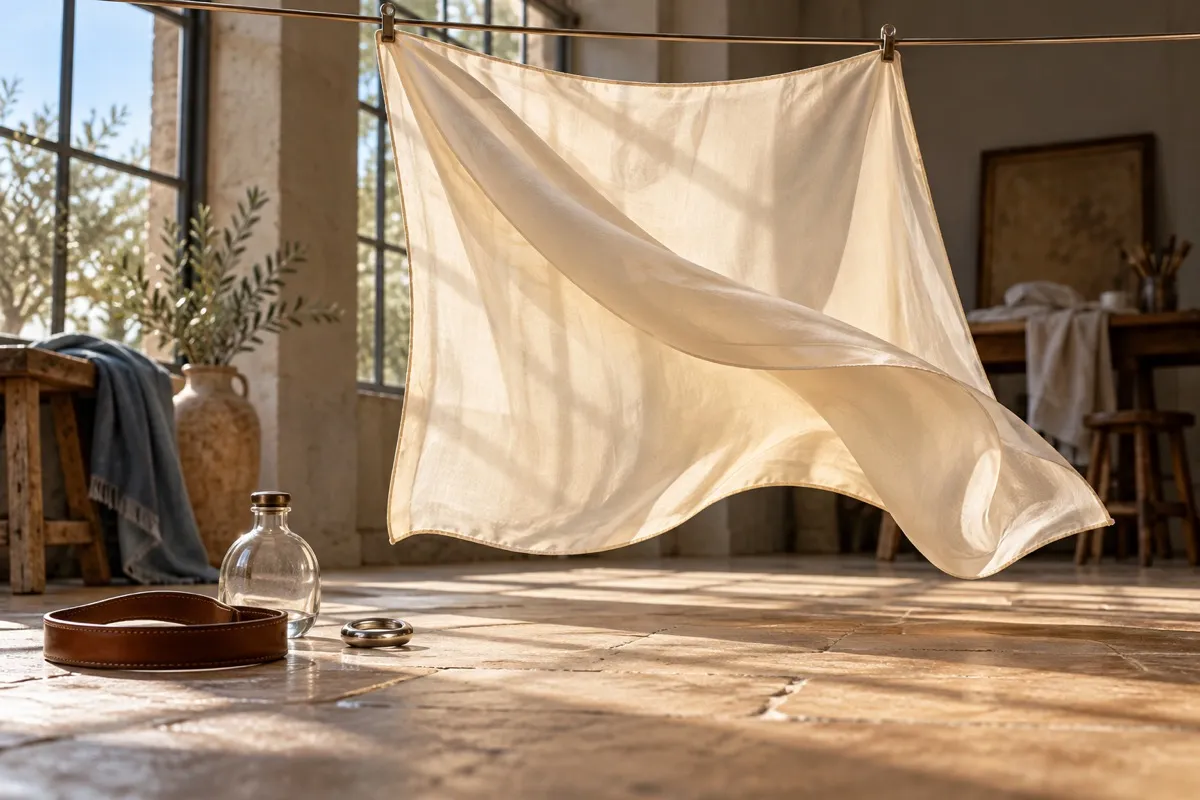
Hermès dates its first silk carré to 1937 and identifies the design as Jeu des omnibus et dames blanches. Its own history credits Robert Dumas with the creation. The important change was the introduction of a repeatable format that could hold many different images. A square of silk could be both an accessory and a small composition, encountered flat and then transformed by folding, knotting and movement.[1]
This was not a replacement for leatherwork. It gave the house another way to connect useful objects with visual invention. A scarf is particularly revealing in that respect: its image need not remain fully legible for its colors and arrangement to matter. The relationship between an object as designed and an object as worn becomes part of the pleasure.
Other developments followed. The house’s published chronology dates Robert Dumas’s Chaîne d’ancre bracelet to 1938 and printed silk ties to 1949. These were distinct categories, not merely different sizes of an existing product. Read together, they suggest an expanding vocabulary of materials and occasions.[2]
Perfume becomes part of the house
Eau d’Hermès, composed by Edmond Roudnitska in 1951, brought a particularly interesting connection between the senses. Comité Colbert’s account describes its inspiration as the interior of a supple leather Hermès bag. The point was not to make fragrance look like saddlery, but to let a memory of leather become the starting point for a different craft.[3]
Guy Robert’s Calèche followed in 1961. Hermès identifies it as its first women’s fragrance and connects the name with its carriage imagery. Here, continuity operated through language and association rather than through the physical reuse of leather. A perfume could belong to the same imaginative world as a bag while having a completely different construction and way of being experienced.[4]
That distinction helps explain the word métier. It is more useful to think of a field of making than a shelf in a shop. Perfume required its own authors and knowledge. Expansion did not mean that every object could be made by the same methods.
The Kelly and a different kind of recognition
In 1956, photographs of Grace Kelly carrying a handbag designed by Robert Dumas in the 1930s gave that design a new public identity. Hermès presents this as the turning point in the Kelly story. The object preceded its association with the princess; the association did not create it from nothing.[1][6]
That difference matters within the wider chronology. Some developments began with a new material or a new field of work. The Kelly demonstrates another route: an existing design could acquire a second life through its wearer. Technical history and public recognition do not necessarily move at the same speed.
The Constance, dated by Hermès to 1967, offered another expression of movement. Its H-shaped closure and sliding shoulder strap brought fastening and carrying into the foreground. Alongside it, the house was extending the wardrobe: Catherine Karolyi took responsibility for women’s clothing and accessories in 1967, while the published product chronology records a first complete men’s ready-to-wear collection in 1978.[7][1][2]
Towards 1984
Clothing also made the relationships between métiers more visible. Hermès dates its combination of knit and silk twill, twillaine, to 1961. Rather than keeping silk exclusively in the accessory drawer, this approach brought it into the garment itself. A material could cross a category boundary without losing its own character.[2]
By 1984, when the Birkin entered the house’s chronology, the setting around a new handbag was therefore quite different from that of the first carré. Hermès had accumulated several ways of designing for daily life. The continuing thread was not that all those things resembled a saddle. It was the more demanding possibility that a house associated with one craft could learn to speak through others.[5]
Sources & further reading
- Six generations of artisans · Hermès1937 · 1937;1951 · 1956 · 1967Consulted 2026-10-27
- 2014 Annual Report · Hermès InternationalPrinted p.17: 1938 · Printed p.17: 1949 · Printed p.17: 1978 · Printed p.17: 1961Consulted 2026-10-27
- Parfums Hermès · Comité ColbertOpening historyConsulted 2026-10-27
- Calèche Soie de parfum · HermèsLa création; Les secrets d’un objetConsulted 2026-10-27
- All about the Hermès Birkin bag collection · HermèsOpeningConsulted 2026-10-27
- All about the Hermès Kelly bag collection · HermèsOpeningConsulted 2026-10-27
- Sac Constance · HermèsOpening · Un fermoir architecturé; La liberté en bandoulièreConsulted 2026-10-27