
An address becomes a point of reference
The number is so familiar that it can seem to have been there from the beginning. It was not. Hermès began on rue Basse-du-Rempart in 1837; Charles-Émile Hermès brought the workshops to 24, rue du Faubourg Saint-Honoré in 1880 and opened a store. The address belongs to the second generation of the business.[1]
That beginning offers a useful way to read the building's later life. It was a place where objects were made and offered to customers, before becoming a subject in its own right. The history of the Faubourg is the gradual accumulation of those roles: working address, point of encounter, stage for display and material for the imagination.
The workshops were not frozen in place. Hermès records that its leather workshops moved from the first floor of the Faubourg building to Pantin in 1992. Remembering that move avoids turning continuity into a misleading picture of everything remaining exactly where it began. A historic address can retain its significance while the work of a growing business finds other spaces.[1]
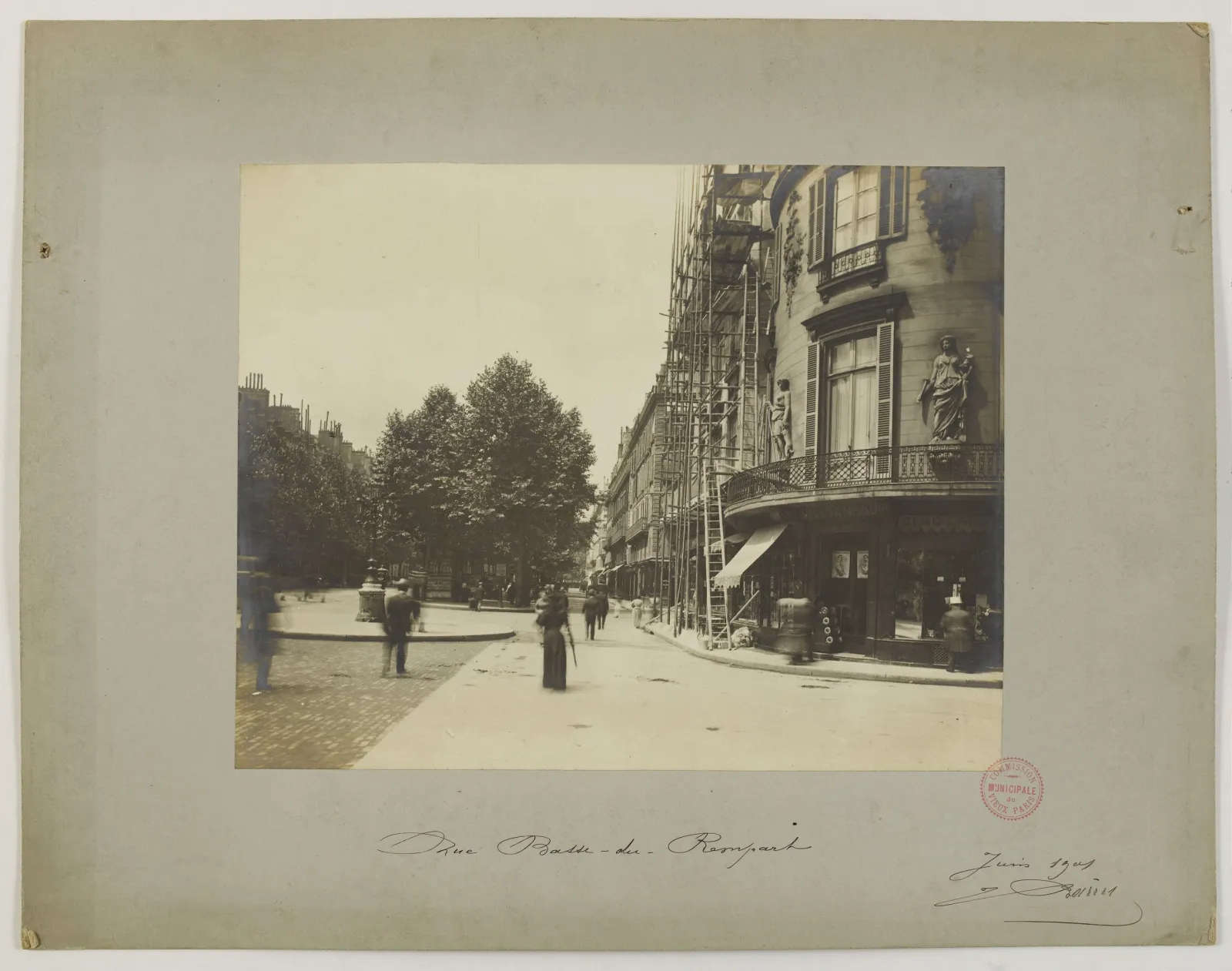
Jean Barry, PH81649. Paris Musées / Musée Carnavalet – Histoire de Paris. CC0 1.0. Unmodified museum reproduction. Source · License
The window as a small stage
For someone passing in the street, the most accessible part of this world has been the window. Hermès' March 2018 shareholder letter recalls that Leïla Menchari joined the house in 1961 alongside Annie Beaumel and took responsibility for the Faubourg displays in 1978. It also describes the 2017 Grand Palais exhibition devoted to her work, where objects were presented in eight compositions.[2][+][+]
A display is a different kind of encounter from a purchase. It asks for attention, but not necessarily possession. A passer-by can stop, look and leave with an image in mind. In this sense, the window turns a store's boundary into a place of exchange with the street. Menchari's place in the Faubourg story matters because the building's identity was shaped by people who arranged and interpreted objects, as well as by those who made or sold them.
What a collection can set in motion
Another route into the house runs through collecting. Émile Hermès assembled works of art, books and objects that became resources for later creation. The value of this activity is clearest when an actual connection can be traced, rather than assumed.[1]
The programme for the Hermès Carré Club in Paris in 2019 gives two examples. A paintbox and an illustrated catalogue from the Émile Hermès collection inspired Pierre Marie's Les Trésors d'un artiste and Virginie Jamin's Fouets et Badines. The programme announced a discussion involving the designers and members of the house's heritage and design teams.[3]
A collection, in this reading, is a working conversation across time. An old object need not be copied whole to remain useful. It may offer a color, arrangement or subject that another maker can reconsider. The documented examples are more illuminating than the vague suggestion that every Hermès design descends directly from an archive.
A garden translated into scent
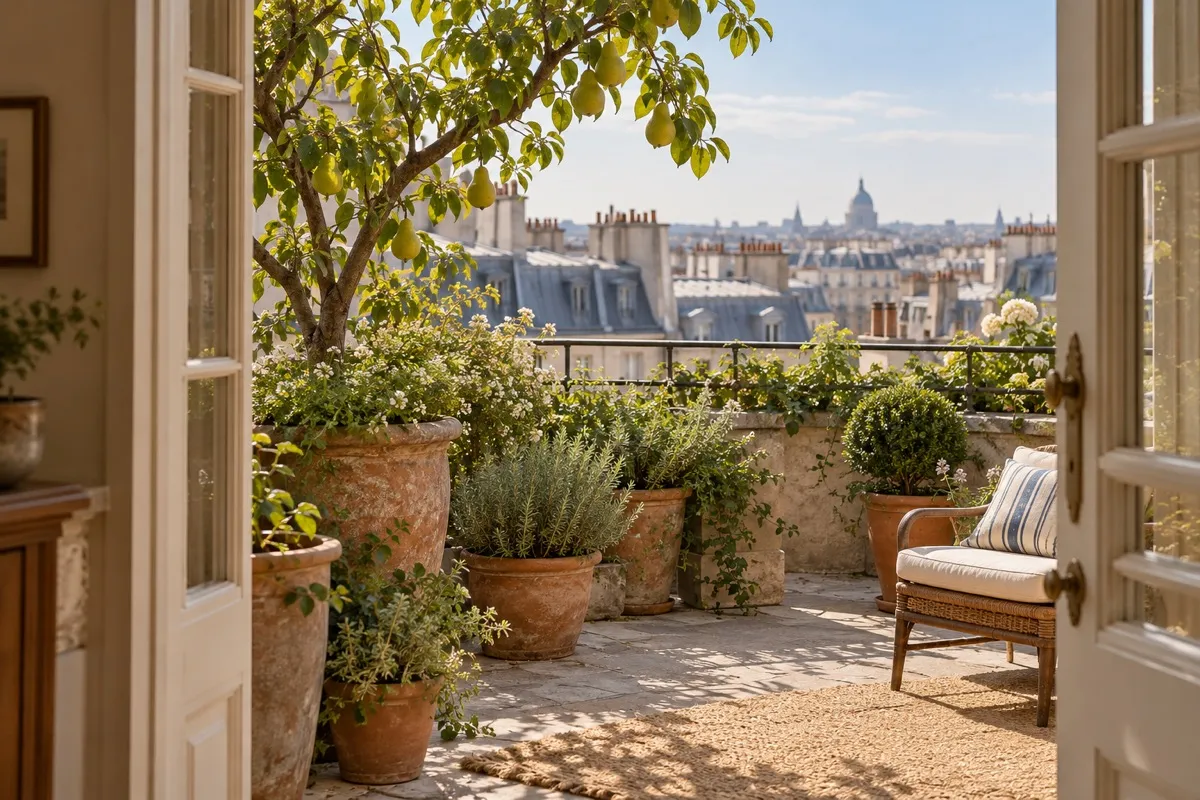
The building has also supplied a different kind of starting point. Jean-Claude Ellena's Un Jardin sur le Toit, created in 2011, takes its inspiration from the garden on the roof of 24 Faubourg. Hermès credits Philippe Dumas with the garden illustration on the packaging and Fred Rawyler with the bottle design, whose shape refers to carriage lanterns.[5]
Here the address can travel without being pictured as a façade. The perfume interprets a place; the package gives it an image; the bottle makes another connection to the house's equestrian world. These are different acts of translation gathered around one location.
The address had already lent its name to Maurice Roucel's 24 Faubourg eau de toilette in 1995. Its sculptural bottle, by Serge Mansau, evokes a silk scarf. The two fragrances offer distinct approaches: one carries the address as a name, while the other begins with a particular space within it.[6]
A place still being retold
In 2024, Hermès chose In the spirit of the Faubourg as its annual theme. The accompanying Le Monde d'Hermès issue was conceived as an inventory of the address, bringing its memories and different activities into print.[4]
That is an apt description of what makes 24 Faubourg worth exploring. Its interest lies less in a single founding legend than in the coexistence of many kinds of work. Workshop, display, collection and garden each offer another way to understand an object. The building becomes memorable because people have continued to find different things to do and different things to notice, within the same address.
Planning a visit? Read the Collector Guide to the Faubourg Saint-Honoré boutique →
Sources & further reading
- Six generations of artisans · Hermès1837 heading · 1880 heading · 1992 heading · 1922 heading, collection paragraphConsulted 2026-10-27
- Letter to Shareholders, March 2018 · Hermès InternationalThe unforgettable window displays of Faubourg Saint-Honoré · Same window-display sectionConsulted 2026-10-27
- Hermès Carré Club Paris programme, 29 November–8 December 2019 · HermèsPDF p. 4; talk on 7 DecemberConsulted 2026-10-27
- Le Monde d’Hermès travelling kiosk press release, 17 June 2024 · HermèsPDF p. 2, Le Monde d’Hermès subsectionConsulted 2026-10-27
- Un Jardin sur le Toit eau de toilette · HermèsCreation · The ObjectConsulted 2026-10-27
- 24 Faubourg eau de toilette · HermèsCreation · The ObjectConsulted 2026-10-27