

Paris before the famous address
The history of Hermès begins with a workshop, rather than a handbag. In 1837, Thierry Hermès established his harness-making business on rue Basse-du-Rempart in Paris. The distinction matters. Harness was equipment for a world in which horses carried people, pulled vehicles and gave movement to the street. To begin here is to encounter leather as something expected to work, before considering it as something to collect.[1]
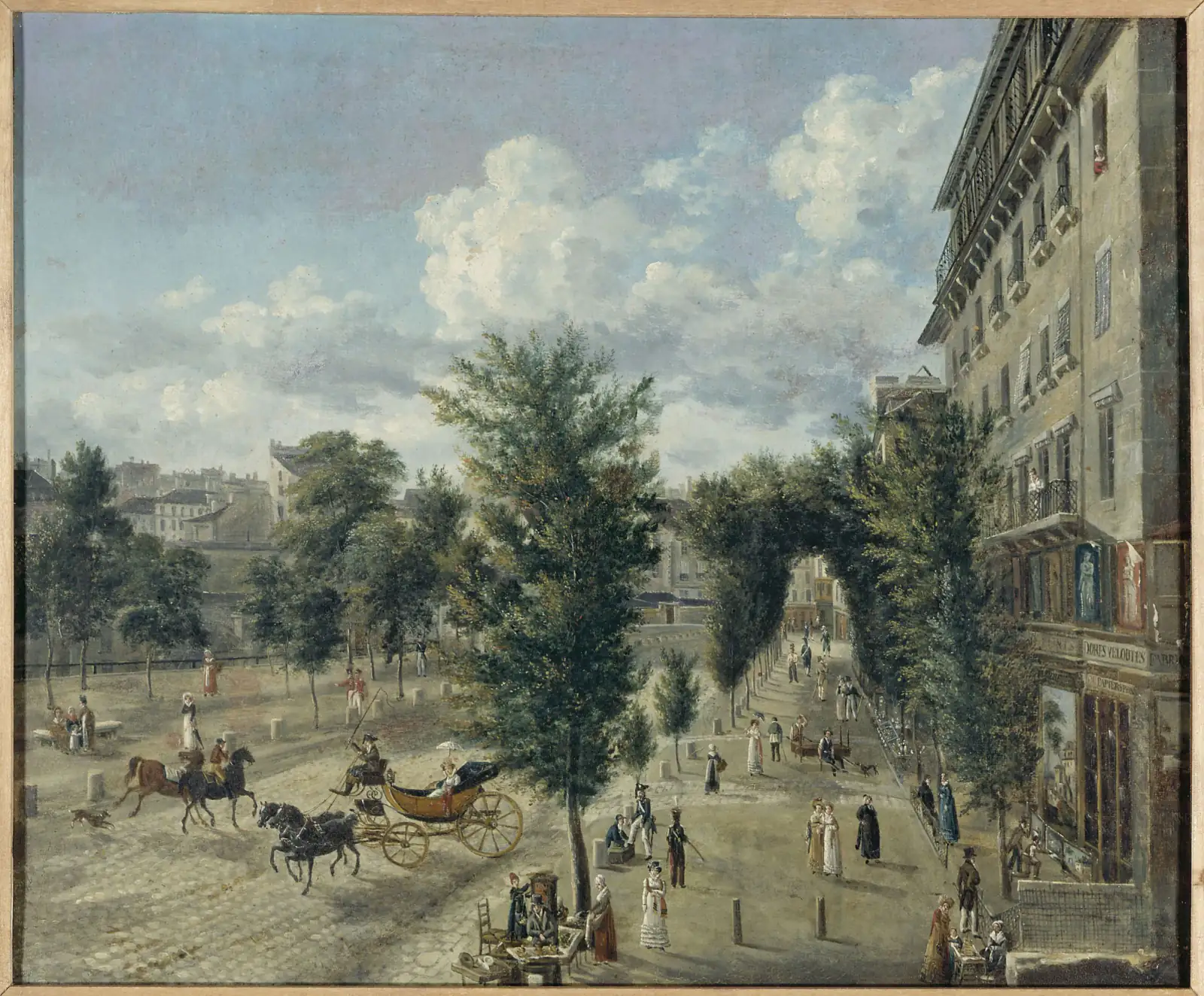
A painting in the Musée Carnavalet offers a way into that setting. Alexandre Pau de Saint-Martin's Le Boulevard des Capucines et la Rue Basse-du-Rempart, dated 1818–1820, predates the workshop. The museum describes riders and horse-drawn vehicles on the tree-lined boulevard, alongside pedestrians, small trades and shop displays on the adjoining street. Someone is transporting a piano. It is a wonderfully practical detail: this was a place where elegant movement shared space with the ordinary business of getting things from one address to another.[2]
The painting is not a portrait of Hermès and it should not be presented as one. Its value is wider. It restores the neighbourhood to a history that can otherwise become detached from its surroundings. Rue Basse-du-Rempart ran along the northern side of the boulevard towards the Madeleine. Thierry's first premises belonged to this urban landscape, not to the later façade that would become so closely associated with the name.[2]
A reputation built on equipment
Hermès records an award for Thierry's work at the Paris Universal Exhibition of 1867. This is an important point of public recognition, thirty years after the workshop opened. The company's historical account connects that recognition to the performance and refinement of its harnesses.[1]
The useful question is what refinement means in an object of this kind. A harness has a job to do. Its appearance cannot be understood independently of the way its parts fit together and serve their purpose. Looking back from today's bags and bracelets, it is tempting to treat every buckle as a future decorative signature. In the nineteenth-century workshop, however, a fastening was first a fastening. That practical starting point makes the later transformations more interesting.
It also encourages a less hurried reading of the early years. The founding date does not mean that the entire modern Hermès world existed in miniature in 1837. The evidence describes a specialist business. Its range and identity would develop through subsequent decisions, rather than appear fully formed at the beginning.
The second generation changes the address
In 1880, Thierry's son Charles-Émile moved the workshops to 24, rue du Faubourg Saint-Honoré and opened a store there. Customers could order made-to-measure harnesses and saddles. The move brought production and selling together at the address that would become the house's best-known Parisian home.[1]
This was already a generational story, but it was also a change in the relationship between a workshop and its customers. A shop provides a place to encounter finished work, discuss an order and return to a maker. Bespoke saddlery makes that exchange especially legible: the object is commissioned for a particular use, rather than chosen only for its image.
At the century's end, the story begins to widen. Hermès dates the Haut à courroies bag to around 1900 in its older chronology; more recent company timelines use 1900. It belongs at the threshold of the next chapter, when carrying equipment and carrying personal belongings would become increasingly important subjects for the business.[4]
Remembering the first street
The original setting did not remain unchanged. Carnavalet holds Jean Barry's photograph of rue Basse-du-Rempart from June 1901. Its catalogue records that the Commission du Vieux Paris had requested a painted view that April because the street was expected to disappear. This does not establish the date when every part of the street vanished, or identify Thierry's workshop in the photograph. It does preserve a city conscious that one of its streets was passing into memory.[3]
The early history of Hermès therefore has two addresses worth remembering. Faubourg Saint-Honoré became the lasting home. Rue Basse-du-Rempart gives the beginning its proper scale: a maker, a workshop and a city whose daily movement created a need for his work.[1]
Sources & further reading
- Six generations of artisans · Hermès1837 heading · 1880 headingConsulted 2026-10-27
- Le Boulevard des Capucines et la Rue Basse-du-Rempart, P752 · Paris Musées / Musée CarnavaletDate de production; inventory P752 · Description iconographiqueConsulted 2026-10-27
- Rue Basse-du-Rempart, PH81649 · Paris Musées / Musée CarnavaletDates; inventory PH81649 · Commentaire historiqueConsulted 2026-10-27
- Document de référence 2018 · Hermès InternationalPrinted p. 11 chronology: Vers 1900Consulted 2026-10-27