
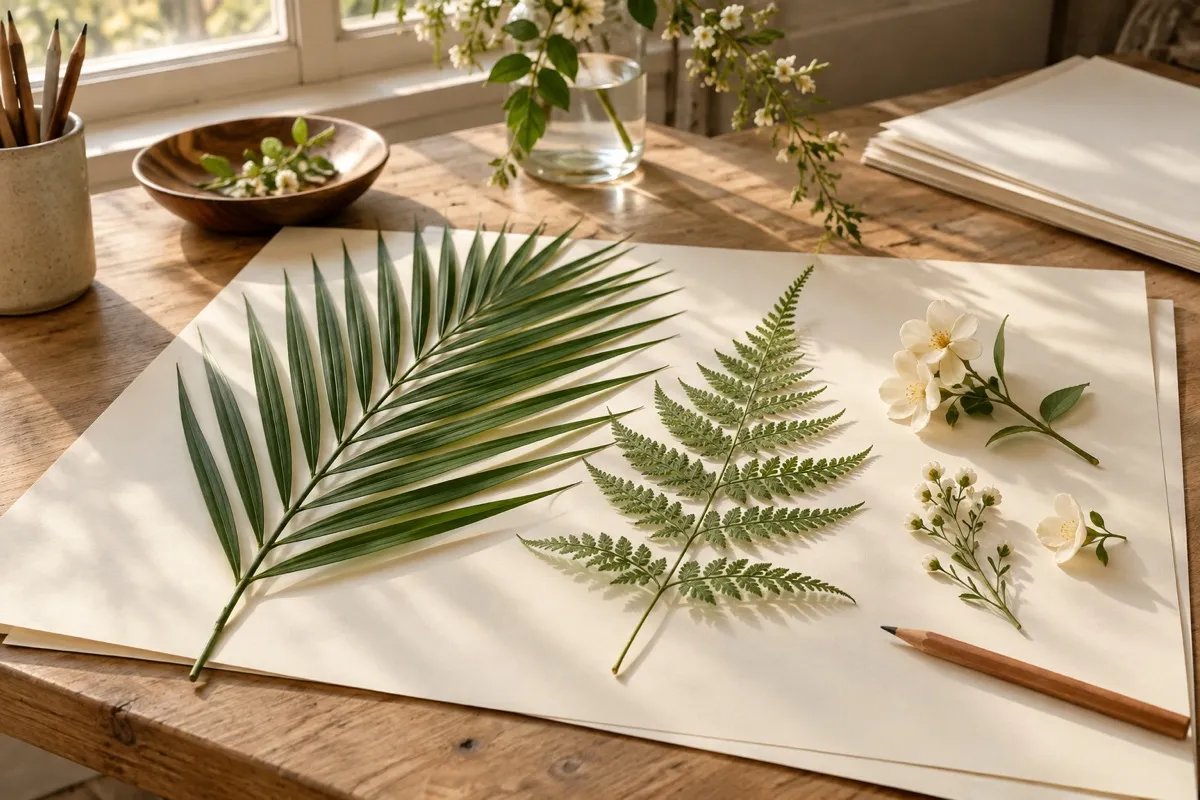
Index Palmarum begins with close attention. Hermès identifies Katie Scott’s inspiration as Historia Naturalis Palmarum, the nineteenth-century palm treatise by Carl Friedrich Philipp von Martius. The house describes her approach through the tradition of botanical plates: selected examples, rather than a claim to show the whole palm family.[1][+][+][+]
That offers a rewarding way into the drawing. Instead of reading a palm as a shorthand for a holiday destination, consider it as a subject worth comparing, one form beside another. An index promises a route through a subject rather than a single view of it. Here, that idea becomes an invitation to slow down, follow the differences and let looking take precedence over naming every specimen.
One documented adaptation is the Index Palmarum Transat embroidered shawl 140, reference H783366S 10. Its cashmere-and-silk fabric carries fine embroidered stripes. Hermès lists the color as Naturel / Bleu / Vert and the dimensions as 136 × 137 cm, with variation possible from hand rolling. These details describe this shawl alone.[1]
The drawing has also been presented as something to contemplate beyond a wardrobe. In its announcement dated 1 June 2023 for the relocated Abu Dhabi store in The Galleria Mall, Hermès names Scott’s Index Palmarum silk carré among the selected artworks. That is a documented moment in the design’s public life, not evidence of its first release.[2]
Seen together, the botanical reference, the textile adaptation and the display context suggest three different encounters: reading, wearing and looking. They need not compete. Each gives the same drawing another setting, while leaving its first-edition year an honest blank in this account.[1][2][+]
What is documented
- Title
- Index Palmarum Source-supportedIndex Palmarum Transat embroidered shawl 140 · Product description and The story behind, lines 36–44 and 80–81
- Artist credit
- Katie Scott Source-supportedIndex Palmarum Transat embroidered shawl 140 · Product description and The story behind, lines 36–44 and 80–81
- First edition
- Unknown Unknown
Sources & further reading
- Index Palmarum Transat embroidered shawl 140 · HermèsProduct description line 40; The story behind lines 80–82 · The story behind line 81 · The story behind line 82 · H1 line 20; Product description lines 36–44 · Product description line 37 · Selected color line 26 · Product description line 42Consulted 2026-10-27
- Hermès relocates and extends its store in The Galleria Mall, reinforcing its presence in Abu Dhabi (UAE) · HermèsSingle PDF page, lines 0–5 and 26–29Consulted 2026-10-27