
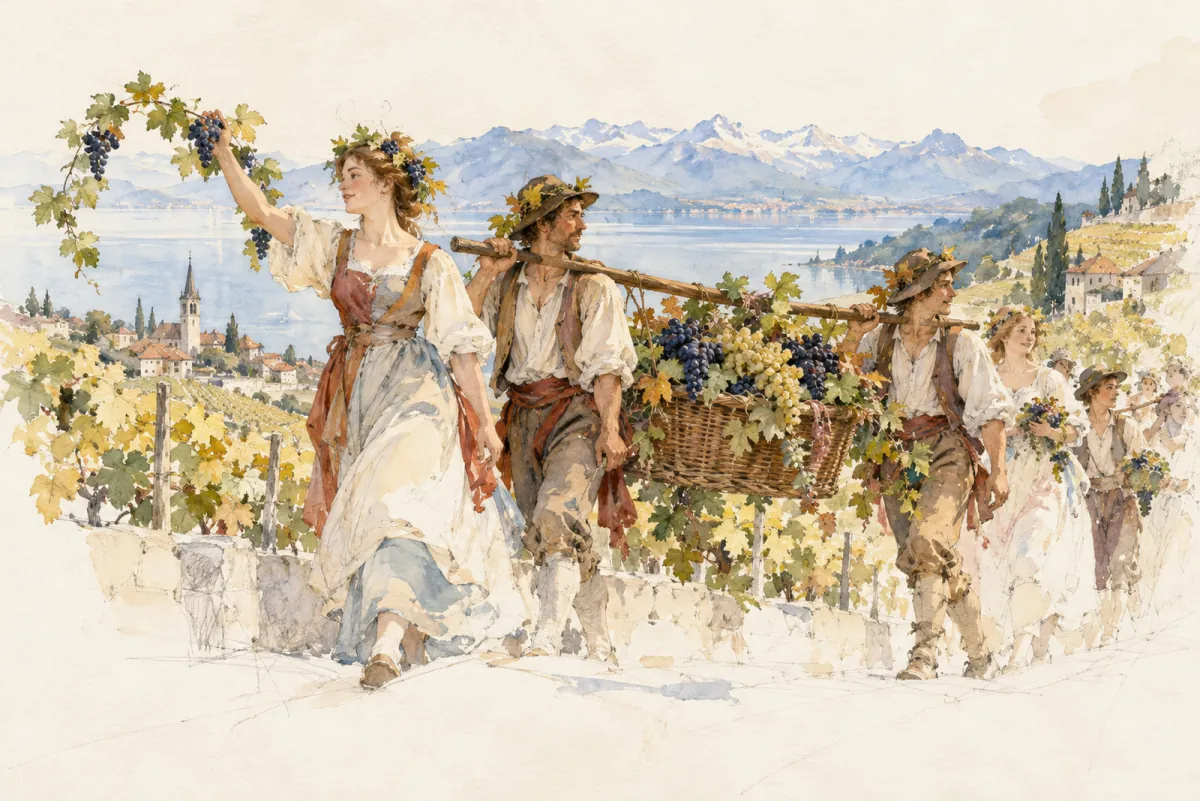
The scarf catalogued as Le cortège des vignerons carries a connection to Vevey, Switzerland, in its recorded title.[1] Cornette de Saint Cyr attributes the 90-centimeter printed silk square to Hugo Grygkar and dates its creation to 1952.[1] Its beige-ground example is compared with another color in Geneviève Fontan’s 2021 reference book, although that book page was not independently consulted.[1] A specialist description also credits Grygkar and links the composition to an illustrated record of the 1833 Fête des Vignerons.[2]
The festival’s own institutional history supplies the setting behind that reference.[3] The Confrérie des Vignerons describes the 1833 celebration as centering on the crowning of winegrowers, followed by performance and a procession through the town with dances at designated stops.[3] David Constantin directed the dancing, Samuel Glady provided music and Théophile Steinlen designed costumes and scenery.[3] The organization records 780 participants, two performances and seating for 4,000 people.[3] These facts describe the historical celebration rather than the later scarf.[3]
Its visual record survives in public collections.[4][5] The Swiss National Library’s archival catalogue identifies an approximately 1833 panorama by Christian Gottlieb Théophile Steinlen, published by Spengler & Cie in Lausanne.[4] It associates the image with the festival held in Vevey on August 8 and 9 that year.[4] The fuller artist name is useful because a bare reference to Steinlen can obscure which artist produced the nineteenth-century festival imagery.[4] The catalogue dates this Steinlen’s life to 1779–1847.[4]
The Institut national d’histoire de l’art documents additional surviving material: an official booklet with woodcut illustrations and two sets of thirty plates drawn by Steinlen.[5] It identifies him as a painter, engraver and teacher in Vevey as well as the designer of the festival’s costumes and scenery.[5] One surviving set was assembled as a roll, turning the moving procession into an image that could be unfolded over time.[5] The roll extends for more than fourteen meters and contains hand-colored versions of the thirty plates.[5] The other set is bound as numbered lithographs, preserving the same sequence in page form.[5] Acquired in 2019, the roll eliminates the breaks between pages to reconstruct the parade as a continuous image.[5] This supplies independent context for the illustrated festival tradition to which the scarf specialist relates Grygkar’s composition.[2][5]
A particularly close point of comparison is Bacchus and his high priest.[2][3] The specialist describes the scarf’s central procession in those terms, while the Confrérie reproduces a captioned detail from the 1833 foldout showing Bacchus preceded by his high priest.[2][3] The historical image and the reported scarf motif therefore share a specific subject, although a complete plate-by-plate comparison has not been established.[2][3] The auction supports the scarf’s artist, material and 1952 creation attribution; the institutional sources explain the older imagery without pretending to date the textile’s production.[1][3][4][5]
Sources and limits
- Le cortège des Vignerons, lot 55 · Cornette de Saint Cyr, notice reproduite par Lot-Art2023-10-31
- Le cortège des vignerons 90 · Abigail Goodman
- 1833 · Confrérie des Vignerons de Vevey
- Fête des Vignerons, GS-GUGE-186-1 · Bibliothèque nationale suisse, HelveticArchivesnotice sans date ; œuvre vers 1833
- La Fête des vignerons de Vevey · Institut national d’histoire de l’art; Pauline Chevaliermis à jour le 2024-12-20
The catalogue’s 1952 creation date is not explicitly an inaugural-release statement. The exact printed artist signature, complete source-image mapping and reissue history remain unverified. The title is also catalogued in the singular as Le cortège des vignerons.