
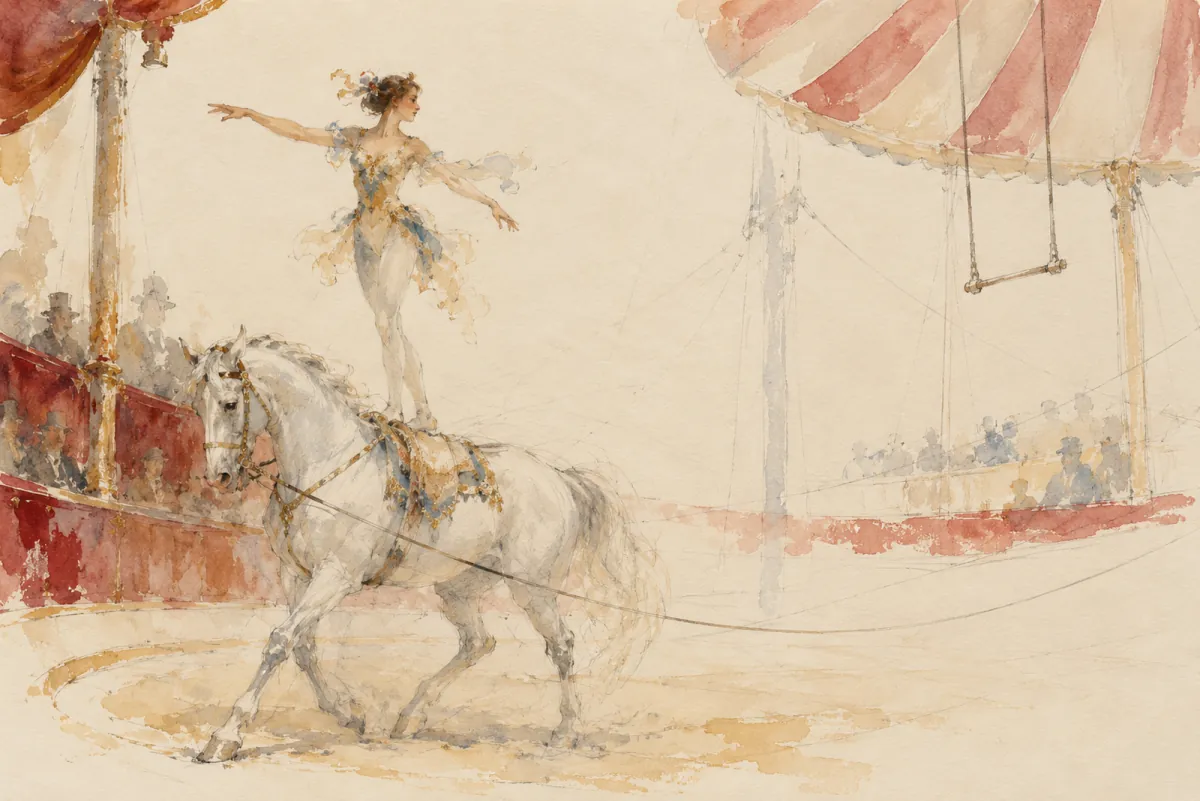
Le cirque molier takes its subject from a Parisian world in which horsemanship and performance shared the same ring: the private circus of Ernest Molier.[1][3] The silk design is attributed to Philippe Dumas in the Élysée auction catalogue, which describes circus scenes and mounted performers against an orange ground with a black border.[1] Another auction record identifies Dumas, gives the date 1983 and describes a signed square measuring 88 by 88 centimeters.[2] These catalogued objects connect the title to a particular equestrian setting while providing evidence for the artist attribution.[1][2]
The historical circus opened in 1880 in a private riding arena on rue de Bénouville near the Bois de Boulogne, according to the Bibliothèque nationale de France.[3] Its performers were amateurs drawn from an aristocratic circle with a shared interest in horses.[3] Their program brought together advanced riding, training demonstrations and equestrian acrobatics alongside small ballets and clown routines.[3] The BnF describes preparations extending throughout the year for an eagerly anticipated event with a select audience.[3] This was an intimate society spectacle organized around the skill of both horse and rider.[3]
The circus also left a visual record beyond the scarf.[3] The BnF holds a fan made from a lithograph by John Lewis Brown and dedicated to Molier in 1883.[3] Its account describes Molier as ringmaster, a female rider, equestrian acrobats and a comic figure leading a cloth horse.[3] The fan is a separate historical object: the BnF entry does not identify it as Dumas's source.[3] It nevertheless documents the combination of riders and comedy associated with the circus that gives the scarf its name.[3] A BnF reading recommendation also points to Molier's illustrated account of the years 1880 to 1904, published in 1905.[4]
The surviving scarf descriptions show how this subject was presented in silk.[1][5] The Élysée example is catalogued as a 90-centimeter square with a hand-rolled hem and a multicolored composition of figures and equestrian scenes.[1] Abigail Goodman records a pink version in the same nominal size, identifies the material as silk and also credits Philippe Dumas.[5] Together these records document different color treatments of the named design, without supplying a complete colorway register or establishing the production date of each individual scarf.[1][5] The measured 88-centimeter auction example should likewise be read as an object measurement rather than proof of a separate named format.[2]
The dating requires a final distinction.[2][5] The auction record associates the drawing with 1983 and Goodman labels that year as the original motif's introduction, but neither supplies an original Hermès release document.[2][5] The historical circus has a firmer endpoint in the institutional account: the BnF dates its annual performances through 1933, the year of Ernest Molier's death.[3] Keeping the circus chronology separate from the scarf chronology preserves what each source actually establishes.[2][3][5]
Sources and limits
- Catalogue, lot 214 · Élyséevente du 2026-03-23
- Le cirque Molier, lot 420 · Gazette Drouotdate non affichée dans l’extrait consulté
- Clowns, chevaux et écuyères · Bibliothèque nationale de France2021
- Le cirque Molier : le rendez-vous mondain de la Belle Époque · BnF, Salle Ovale
- Le Cirque Molier 90 · Abigail Goodman Scarf Boutique
The consulted records do not establish the exact printed form of the artist’s signature or a primary-source release date. They do not establish a complete reissue history, other formats or a connection to a documented annual Hermès theme. The historical fan is not established as the model for the scarf.