
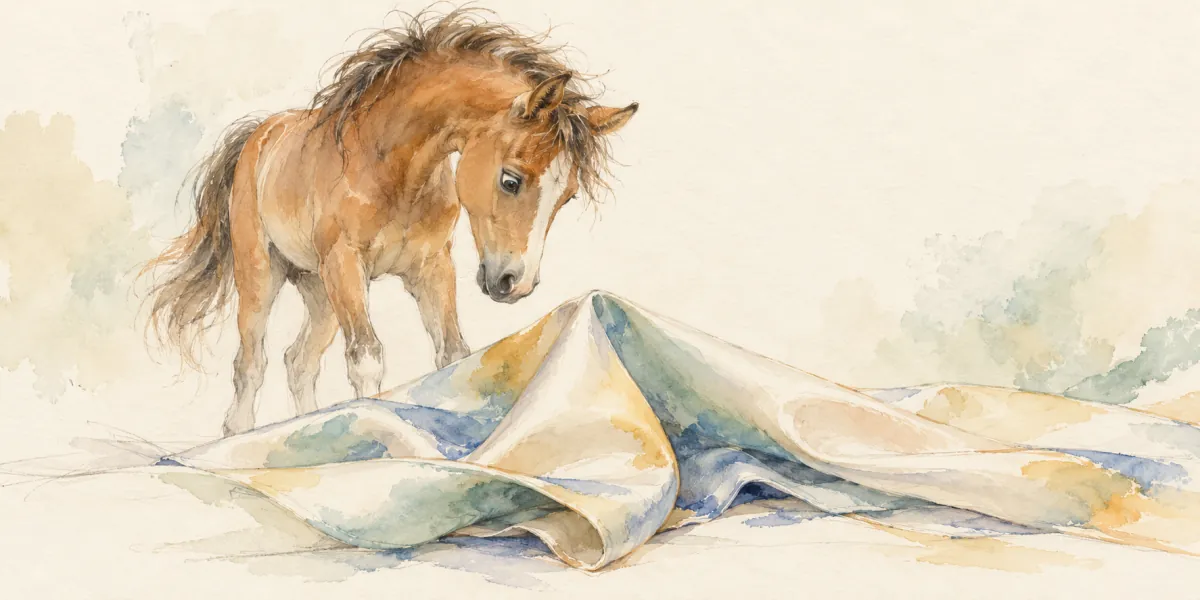
Cheval surprise turns the act of looking into part of the design.[1] In a 2026 interview, Dimitri Rybaltchenko explains that the composition grows from ambiguous marks in which horses gradually become recognizable.[1] He connects this approach with pareidolia, the perception of familiar images within apparently abstract forms.[1] Rather than presenting a fully outlined animal immediately, the drawing leaves room for discovery as the viewer’s eye assembles an image.[1] The artist describes the work as a way of imagining the birth of an idea.[1]
Rybaltchenko places the scarf within a wider habit of seeing imaginary worlds in marks and surfaces.[1] In the same interview he discusses the personal associations that colors, letters and numbers hold for him.[1] These observations illuminate his approach without proving that every mark on this particular scarf carries a fixed symbolic meaning.[1] His own explanation makes Cheval surprise a particularly clear example of an image that depends on the viewer’s imagination as well as the designer’s drawing.[1]
A house chronology deposited with the French financial authorities associates Cheval surprise with 2004.[2] This is documentary evidence from Hermès itself, distinct from the artist’s retrospective account more than twenty years later.[1][2] It provides an early chronological anchor, although the consulted chronology does not supply a day of release or a seasonal booklet.[2] An independent auction catalogue attributes a white-toned 90-centimeter silk square to Dimitri Rybaltchenko, confirming the artist and a conventional square format through an individual object record.[3]
The design is also represented in a museum collection.[4] The Museum of Fine Arts, Boston lists a black, white and orange Cheval surprise silk scarf among acquisitions for July 2013 through June 2014.[4] The entry credits Dimitri Rybaltchenko as designer, identifies Hermès as the house and records the bequest of Dale A. Roberts.[4] Its accession number is 2014.760.[4] That number belongs to the museum’s acquisition record and should not be mistaken for the design’s creation date.[2][4] The institutional entry documents one color treatment rather than a complete catalogue of editions.[4]
A current Hermès product record documents a double-sided interpretation in the Carré 90 category.[5] It credits Rybaltchenko, specifies silk twill with hand-rolled edges and gives dimensions of 88.5 centimeters square, noting that measurements may vary because of the hand-rolling.[5] The listed color combination is black, white and emerald, under product reference H904353S 01.[5] Hermès also identifies France as the place of manufacture and specifies that the textile is entirely silk.[5] These details belong to the current double-sided version, not automatically to every earlier object bearing the title.[5] Printing on both sides gives this version a documented material distinction from the museum’s more simply described silk scarf.[4][5] The current product page establishes the existence and construction of that version, but does not date its introduction or map every intervening edition.[5]
Sources and limits
- Чарівні сни Димитрія Рибальченка · L’Officiel Ukraine; entretien Oleksii Nilov2026
- Document Hermès déposé à l’AMF · Hermès; AMF, DILA2009-09-14
- Catalogue, lot 188 · Catalogue de vente, avril 20252025-04
- Annual Report Acquisitions 2013–2014 · Museum of Fine Arts, Boston2014
- Carré 90 double face Cheval Surprise · Hermès
The exact printed artist signature is not established by these records. The sources do not provide a complete reissue chronology or the launch date of the double-sided version. No annual-theme connection is established.