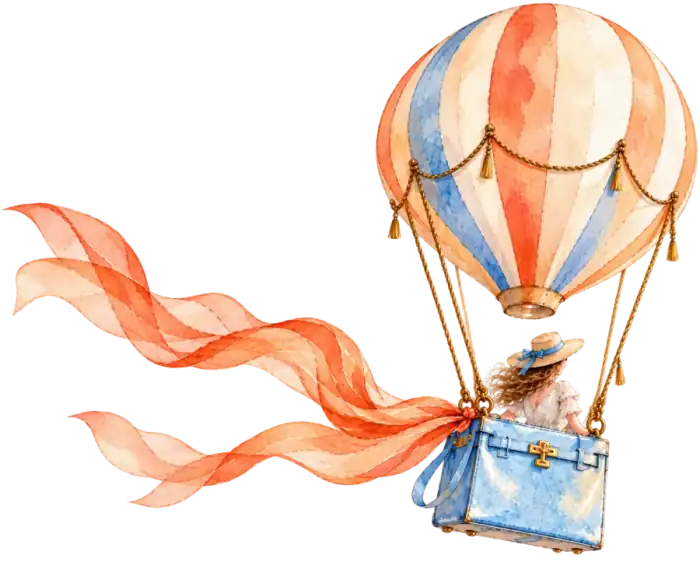

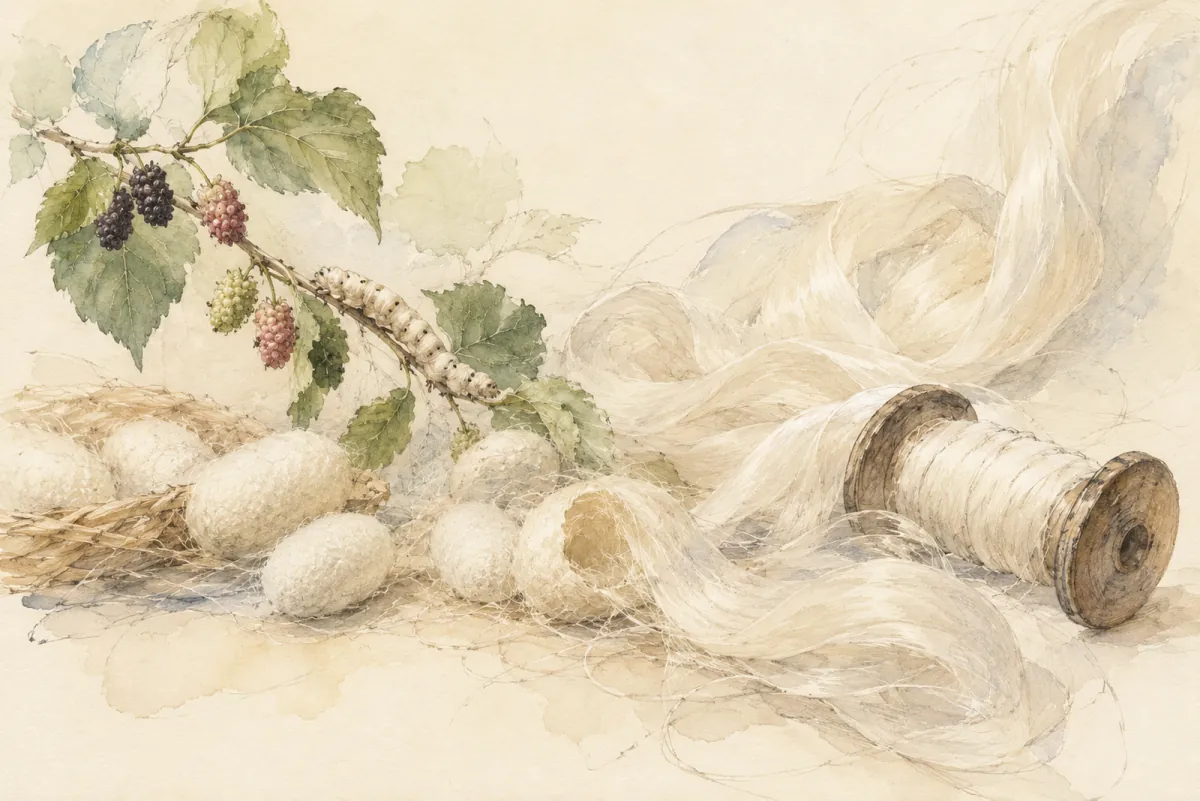
Gallery 63’s catalogue interprets Au fil de la soie as a sequence about the silk trade. In its description of a silk example, the small scenes connect travellers mounted on elephants, silk reeling in China and views of Venice. The reading of the composition as a textile-production narrative belongs to that auction catalogue, rather than to a newly discovered statement by Annie Faivre.[1]
The same record identifies the design title in a banner and describes a separate Hermès inscription framed by winged horses. Its approximately 90-centimeter silk square has hand-finished rolled edges. Artcurial supplies a useful comparison: a cashmere-and-silk shawl under the same title, credited to A. Faivre and measured at 133 centimeters. These are records of particular objects, not a universal specification for the design.[1][2]
Both auction houses report 1995, but their historical sources are unspecified. Matching catalogue dates do not establish independent historical corroboration or replace a contemporary Hermès issue document. The detailed visual reading above depends principally on Gallery 63 and no claim about Faivre’s research process or historical sources is made.[1][2]
Sources and limits
2 recorded evidence origins. Distinct publishers do not establish independent historical corroboration.
- Au Fil de la Soie, lot 319 · Gallery 63Consulted 2026-10-27 · openedDescription, lines 45–47 · No demonstrated copying; historical-data independence not established.
- Au Fil de la Soie, lot 169 · ArtcurialConsulted 2026-10-27 · openedDescription, lines 253–258; sale 2415 · No demonstrated copying; historical-data independence not established.
The design identity and correspondence of individual versions remain unconfirmed. Separate publishers do not demonstrate independent historical dating. Narrative is a qualified auction-catalogue reading, not a first-party account of Annie Faivre’s intention; the opening sentence now explicitly attributes that reading.